
Yes. Corporate health screening can work for a small business of 10 to 50 people. With The Livewell Syndicate there's no minimum group size, a qualified practitioner comes to your workplace, and each appointment typically takes about 20 minutes. You buy the number of places you want, you decide who gets them, and our calculator gives an estimate for your own headcount.
Does screening suit small teams?
Yes. There's no minimum group size, and a small firm that offers screening to everyone is in the minority.
It does. Workplace screening with us has no minimum group size. We recommend at least 20 people, but a smaller team is still welcome.
So if you run a team of 12, you're not too small to ask. Tell us how many people you have and what you'd like to offer them, and we'll talk it through with you.
It's also a benefit that fewer small firms offer. In the CIPD's 2025 survey of UK employers, 23% of private sector small and medium sized employers (2 to 249 staff) offered health screening to all their employees. Among large private sector organisations (250 or more staff), it was 47%.
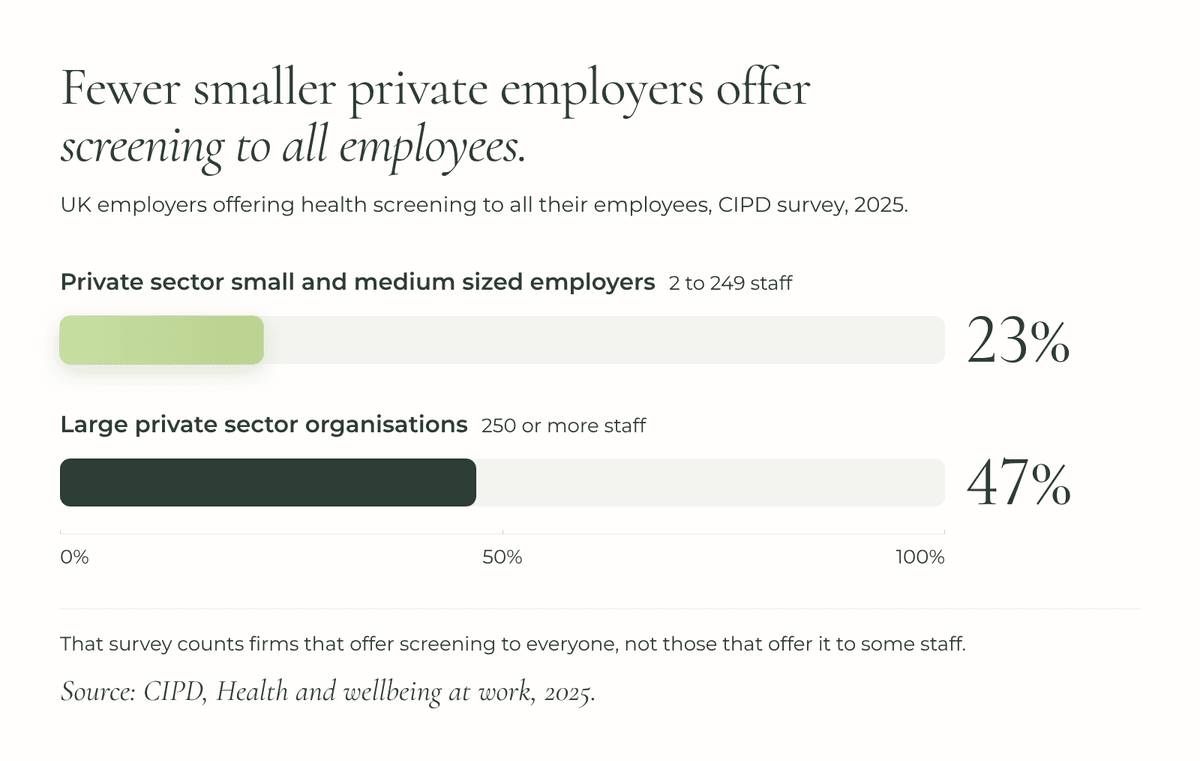
That survey counts firms that offer screening to everyone, not those that offer it to some staff. Even so, it puts a small firm that offers it to the whole team in the minority. We looked at those figures in more depth in small firms and staff health: the provision gap in numbers.
What you actually buy
A fixed number of places on a panel you choose, given to the people you pick.
You buy a fixed number of places, and you decide who receives them. That might be everyone or a particular group, and it's your call.
Each place is for a blood test panel. Employers typically choose one of two options:
the Advanced Essential Blood Test
the Advanced Well Man and Advanced Well Woman Blood Tests
Bespoke packages can also be put together for executives, if you'd like something different for a few senior people.
Whatever you choose, a qualified practitioner comes to your workplace to take the samples. A programme can also run across several days, with more than one practitioner.
Each person gives a blood sample from a vein in the arm. That's called a venous blood draw.
How much does it cost?
It depends on the places you buy and the panel you choose, and our calculator works it out for your headcount.
The cost depends on how many places you buy and which panel you choose. This article doesn't give prices. Our corporate wellness page has a calculator, in the section called The numbers, that shows an estimated cost for your own headcount, and every programme is quoted to your brief.
What the calculator shows
The calculator opens with a question: "What is ill health costing your business each year?" It then puts its estimate of that cost beside the cost of the programme.
You can change every default figure, and the estimate updates as you type. If you know your own headcount or your own sickness days, put them in.
There's also a savings slider, under the heading "Test your own assumption". It starts at zero, because no published study gives a reliable figure for how much blood screening alone reduces the cost of ill health. You can move it yourself, but we won't start you off with a saving we can't back up.
How does the day run?
From agreeing the plan to each person opening their own results, in seven steps.
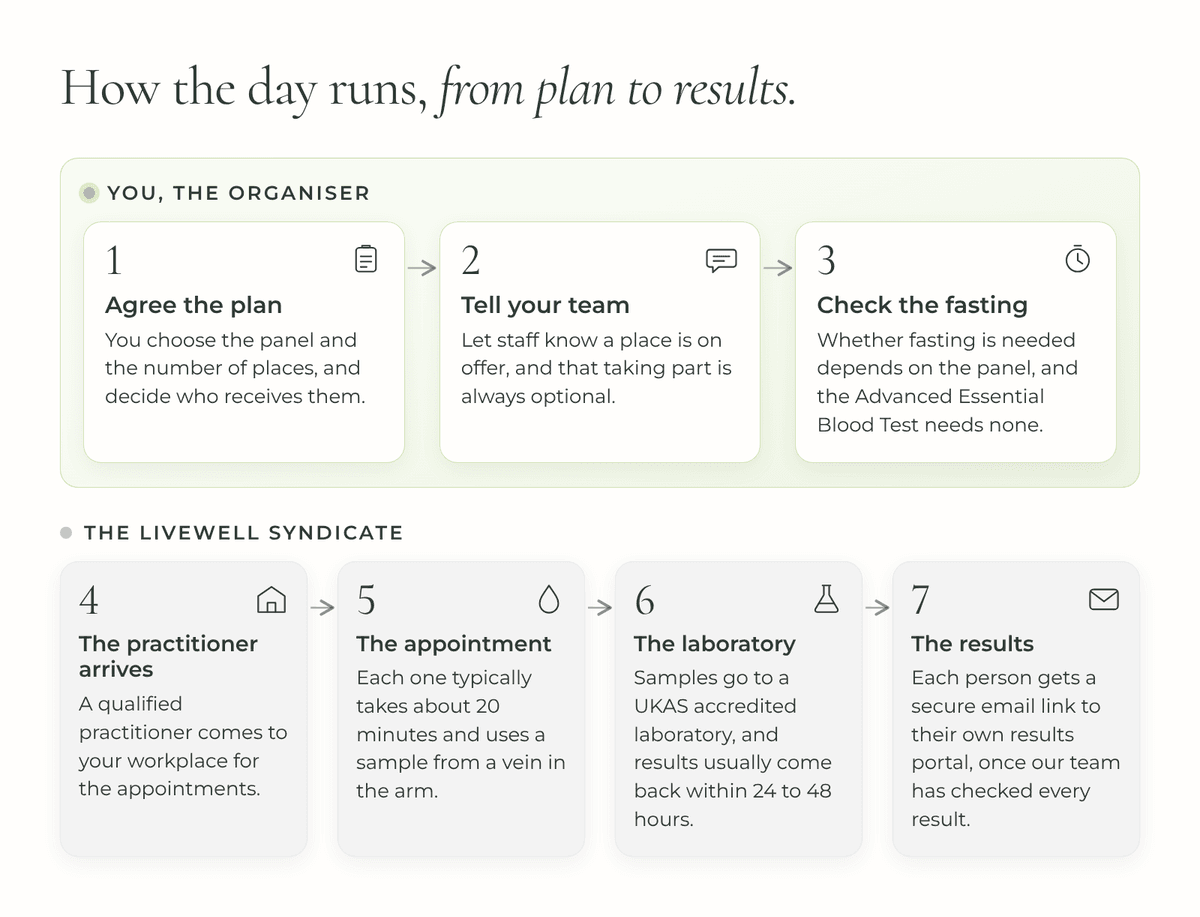
A screening day is a set of short appointments at your workplace. Here's how it runs, from your first conversation with us to each person reading their results.
Agree the plan
You choose the panel and the number of places, and decide who receives them.
Tell your team
Let staff know a place is on offer, and that taking part is always optional.
Check the fasting
Whether fasting is needed depends on the panel, and the Advanced Essential Blood Test needs none.
The practitioner arrives
A qualified practitioner comes to your workplace for the appointments.
The appointment
Each one typically takes about 20 minutes and uses a sample from a vein in the arm.
The laboratory
Samples go to a UKAS accredited laboratory, and results usually come back within 24 to 48 hours.
The results
Each person gets a secure email link to their own results portal, once our team has checked every result.
Some more advanced panels take longer than 24 to 48 hours to come back, so if timing matters to you, ask us when you plan the day.
If you're comparing providers, our article on five questions to ask before you book health checks for your staff covers laboratory accreditation and the other things worth checking.
What to sort out beforehand
The few decisions that sit with you as the organiser.
As the organiser, you have a few decisions to make and one message to get right.
Who gets a place
You buy a fixed number of places, so decide who they're for before you invite anyone.
Which panel
Employers typically choose the Advanced Essential Blood Test, or the Advanced Well Man and Advanced Well Woman Blood Tests.
Optional, said plainly
Taking part is always optional, so say so clearly in the invitation.
Fasting
Check whether your panel needs fasting, so nobody turns up having had breakfast when they shouldn't.
Privacy
Tell people up front that you won't see anyone's individual results.
That last point matters more in a small team. In a business of 10 or 15 people, where everyone knows everyone, staff may wonder whether the boss will see their cholesterol.
You won't. The employer never sees any individual's results, and receives only anonymised, group level data. Our article on who sees your results when your employer pays for screening explains how that works, and what to ask if your team is small.
For anything else about the practical side of the day, ask us when you get in touch.
What each person gets
Their own results, checked by our team and explained marker by marker.
Each person gets their own results, through a secure email link to their own results portal.
Every result is checked by our team before it's released. Alongside the numbers, each person gets an explanation of what each of their markers measures, and what it can and can't show. For more on that, read what a workplace blood test can and can't tell you.
What happens next is up to them. With their consent, their results can be shared, for example with their GP or occupational health. If a result sits outside the lab's range, it's something to take to their GP.
For you as the owner, that means a team where each person has a clear, explained picture of their own health from a short appointment at work.
Common questions
Short answers to what small business owners ask about workplace health screening.
How much does workplace health screening cost per employee?
It depends on the panel you choose and how many places you buy. The calculator on our corporate wellness page shows the figures for your own headcount, and you can change every default to match your business.
Is there a minimum number of staff for workplace health screening?
Not with The Livewell Syndicate. There's no minimum group size, though we recommend at least 20 people. If your team is smaller, you're still welcome to ask.
How long does a workplace health check take?
Each person's appointment typically takes about 20 minutes. The practitioner takes a blood sample from a vein in the arm.
Do staff have to take part?
No. With us, taking part is always optional for staff. Our article on five questions to ask before you book health checks for your staff explains what the ICO says about keeping it a free choice.
How quickly do results come back?
Results usually come back within 24 to 48 hours, and some more advanced panels take longer. Each person gets a secure email link to their own results portal, and every result is checked by our team before it's released.
Can a small business offer health screening as a staff benefit?
Yes. There's no minimum group size, a qualified practitioner comes to your workplace, and you decide who receives the places you buy.
Was this article helpful?
Screening for your team
On-site and clinic health screening, scoped to your organisation.
Book a discovery call
Daniel SnowWritten by · BSc (Hons), PGCE
This article is for general information only and is not medical advice. If you have symptoms or concerns, speak with a qualified clinician.