
When The Livewell Syndicate runs workplace health screening, the employer never sees any employee's individual results, only anonymised, group level data. More widely, UK data protection law treats health information as special category data, which needs more protection because it's likely to be more sensitive. Anyone using it needs a lawful basis plus an extra condition.
Why is health data treated differently?
UK data protection law puts health information in a special category with extra rules.
Health information sits in its own category in the law. Under UK GDPR, data concerning health is one of the special categories of personal data. The Information Commissioner's Office (ICO) calls health information "some of the most sensitive personal information you might process about your workers". It says special category data "needs more protection because it's likely to be more sensitive".
In practice, that means a higher bar. To use health information lawfully, an organisation needs a lawful basis under Article 6 of UK GDPR and, on top of that, a separate condition under Article 9. The ICO notes that the two "don't have to be linked".
ICO guidance for employers adds some plain principles. Workers "can legitimately expect that employers will respect their privacy when handling their health information". Employers shouldn't collect more health information than they really need for their stated purpose. Managers should only have access where their management responsibilities need it. As far as possible, information on medical conditions should stay with health professionals such as doctors and nurses.
The ICO also says employers should tell workers that their health information is being collected and why, who will have access to it, and when. It says collecting it covertly is unlikely ever to be justified.
The law doesn't ban employers from ever seeing health information. It does ask a lot of anyone who handles it. At our screening sessions, the employer never sees any individual's results.
What does my employer actually get?
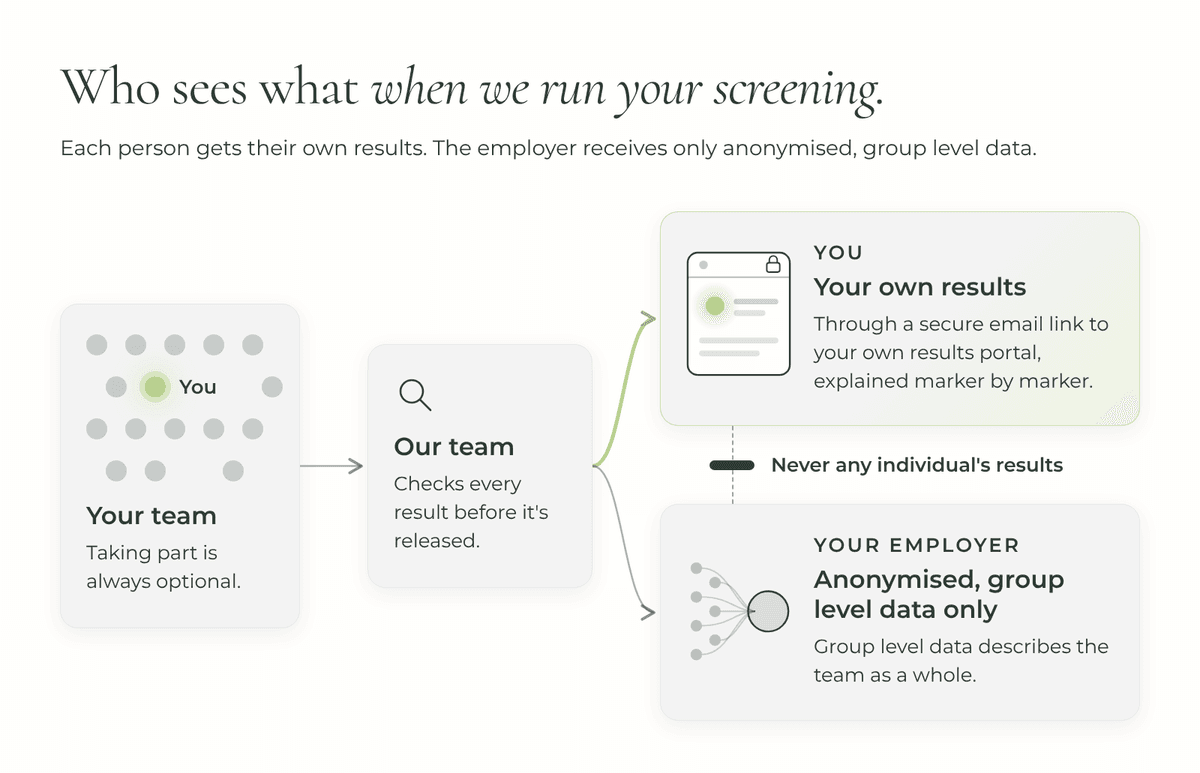
With us, the employer receives anonymised, group level data and never any individual's results.
Your employer gets anonymised, group level data. It never sees your individual results. Group level data describes the team as a whole.
"Anonymised" has a specific meaning in data protection. The ICO says information is anonymised when no means are "reasonably likely" to be used, by the organisation or anyone else, to identify the people in it. It's also honest about the limits: "It is not always possible to reduce identifiability risk to a level of zero". The aim is for that risk to be "sufficiently remote".
Why small groups need care
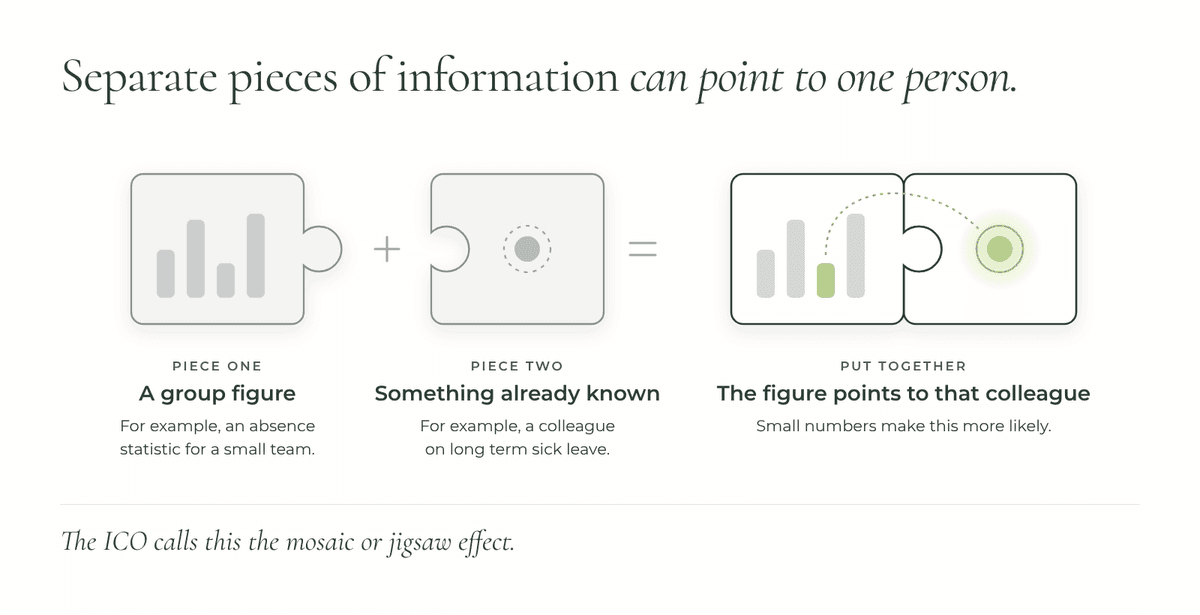
Small numbers make that harder. The ICO gives the example of an employee who works out that an absence statistic relates to a colleague they know is on long term sick leave. Separate pieces of information, put together, can point to one person. The ICO calls this the mosaic or jigsaw effect.
In another ICO example, an organisation stopped releasing statistics it had released in earlier years. Part of the reason was that fewer people were now in its programme, which made it more likely someone could be identified. If your team is small, it's a fair question to ask any provider how its group report handles that. Our answer: we never show a group figure for fewer than 5 people, and for small teams we may set a higher minimum.
Side by side, this is who sees what when we run your screening.
Your employer
Anonymised, group level data only, and never any individual's results.
You
Your own results, through a secure email link to your own results portal, checked by our team and explained marker by marker.
Do I have to take part?
Taking part is always optional for staff at our screening sessions.
No. At our workplace screening sessions, taking part is always optional for staff.
The ICO's guidance points the same way. It says an occupational health and wellbeing programme may include testing workers' health where workers have a free choice to take part. Its checklist for employers asks whether testing is part of a programme "that workers have a free choice to participate in".
Where does consent come in?
Consent means three different things here, and it helps to keep them apart.
Consent comes up in three different ways, and they're easy to mix up.
Choosing to take part
The first is your choice to come along on the day. With us, that's always optional.
Sharing your own results
The second is passing your results on. With your consent, your results can be shared, for example with your GP or occupational health.
The ICO has guidance on occupational health schemes. It says workers may assume that what they tell a doctor, nurse or other health professional is confidential, unless they're told otherwise. It adds: "Generally, you need to obtain explicit consent for the release of such information to non-medical staff."
Consent as a legal basis
The third is the legal sense: consent as the lawful basis an organisation relies on to use health information. ICO guidance says employers "will generally be in a position of power" over their workers, so they may find consent difficult to rely on. For it to work, a worker must be able to refuse "without fear of a penalty being imposed", and must be able to withdraw consent at any time.
The ICO's general guidance on consent says it won't usually be appropriate where there's a clear imbalance of power. Employers should usually look for another basis for staff data. Employers "are not banned from using consent", though. It can work where the choice is genuinely optional and saying no has no adverse consequences.
One ICO example shows where consent can work for voluntary health screening, where nobody has to take part and taking part isn't counted in performance reviews.
If you've been offered a place
The path your sample and your results take, from the appointment to your own portal.
If your employer has offered you a place, this is the path your sample and your results take. Whether you need to fast depends on the panel being run.
The appointment
It typically takes about 20 minutes, and the sample is taken from a vein in your arm.
The laboratory
Your sample is processed by a UKAS accredited laboratory.
The check
Every result is checked by our team before it's released.
Your results
A secure email link takes you to your own results portal, where each result is shown against the laboratory's reference range.
The explanation
It covers what each of your markers measures and what it can and can't show.
What you do next is your call. You can keep your results to yourself, or have them shared with your GP or occupational health with your consent. If a result sits outside your lab's range, it's something to take to your GP.
Questions to ask any provider
Five privacy questions an HR lead can put to any screening provider before booking.
If you're weighing up screening for your team, ask about privacy early, and ask every provider, us included. Our article on five questions to ask before you book health checks for your staff covers the basics, including who sees individual results. These five go a step further, and each one comes from the ICO guidance above.
What staff are told
What will our staff be told, in writing, about who can see their results and why?
The group report
What will we receive, and how do you stop a small group's figures pointing to one person?
Manager access
Will any manager see health information, and if so, why does their role need it?
Only what's needed
Does the report hold only what we need for our stated purpose?
Sharing onwards
If results go to a GP or occupational health, how is each person's consent asked first?
With us, every result is checked by our team before it's released, and the employer receives only anonymised, group level data.
Common questions
Short answers to the questions people search for about workplace screening and privacy.
Can my employer see my blood test results?
Not when The Livewell Syndicate runs your workplace screening. Your employer never sees any individual's results and receives only anonymised, group level data. ICO guidance also says managers should only have access to workers' health information where their management responsibilities need it.
Is workplace health screening confidential?
With us, your results come to you through a secure email link to your own results portal, and your employer receives only anonymised, group level data. In its guidance on occupational health schemes, the ICO says workers may assume that what they tell a health professional will be treated in confidence unless they're told otherwise.
Do I have to take part in a workplace health check?
With us, no. Taking part is always optional for staff. ICO guidance says testing as part of a wellbeing programme should be a free choice for workers.
Can I share my results with my GP?
Yes. With your consent, your results can be shared, for example with your GP or occupational health.
Can my employer ask for my medical records?
In England, an employer can't ask your own doctor for a medical report about you for employment purposes without telling you first and getting your consent. That rule comes from the Access to Medical Reports Act 1988. It covers reports from a doctor who is or has been responsible for your care, such as your GP. ICO guidance also says employers shouldn't ask workers to consent to the disclosure of their entire medical record unless absolutely necessary.
Was this article helpful?
Screening for your team
On-site and clinic health screening, scoped to your organisation.
Book a discovery call
Daniel SnowWritten by · BSc (Hons), PGCE
This article is for general information only and is not medical advice. If you have symptoms or concerns, speak with a qualified clinician.