On site health screening brings the blood test to your workplace. A qualified practitioner comes to your site and works from a private room, with samples usually taken before 11:00. Each person who takes a place has an appointment of about 20 minutes and gives a sample from a vein in the arm. They then get their own results, checked by our team, and you as the employer get anonymised trends for the group.
The programme, step by step
The whole programme in order, from choosing places to your report.
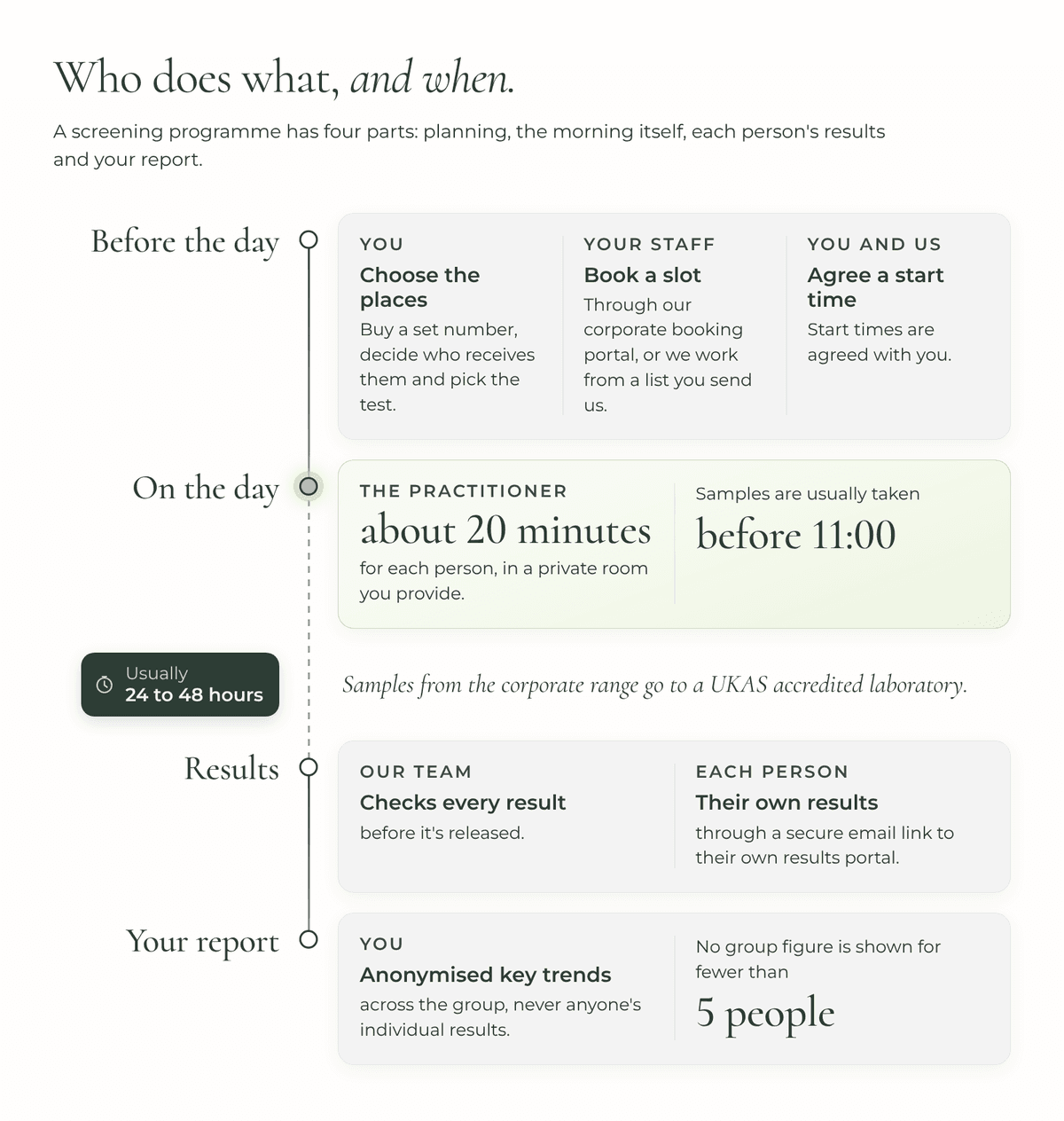
A screening programme has four parts: planning, the morning itself, each person's results and your report. Here's who does what, and when.
You choose the places
You buy a set number of places, decide who receives them and pick the test.
Staff book a slot
They book through our corporate booking portal, or we work from a list you send us.
We agree a start time
Start times are agreed with you, and samples are usually taken before 11:00.
The appointments
A qualified practitioner sees each person for about 20 minutes, in a private room you provide.
The laboratory
Samples from the corporate range go to a UKAS accredited laboratory, and results usually come back within 24 to 48 hours.
Each person's results
Our team checks every result, then each person gets a secure email link to their own results portal.
Your report
You receive anonymised key trends across the group, never anyone's individual results.
A bigger programme can run across several days, with more than one practitioner.
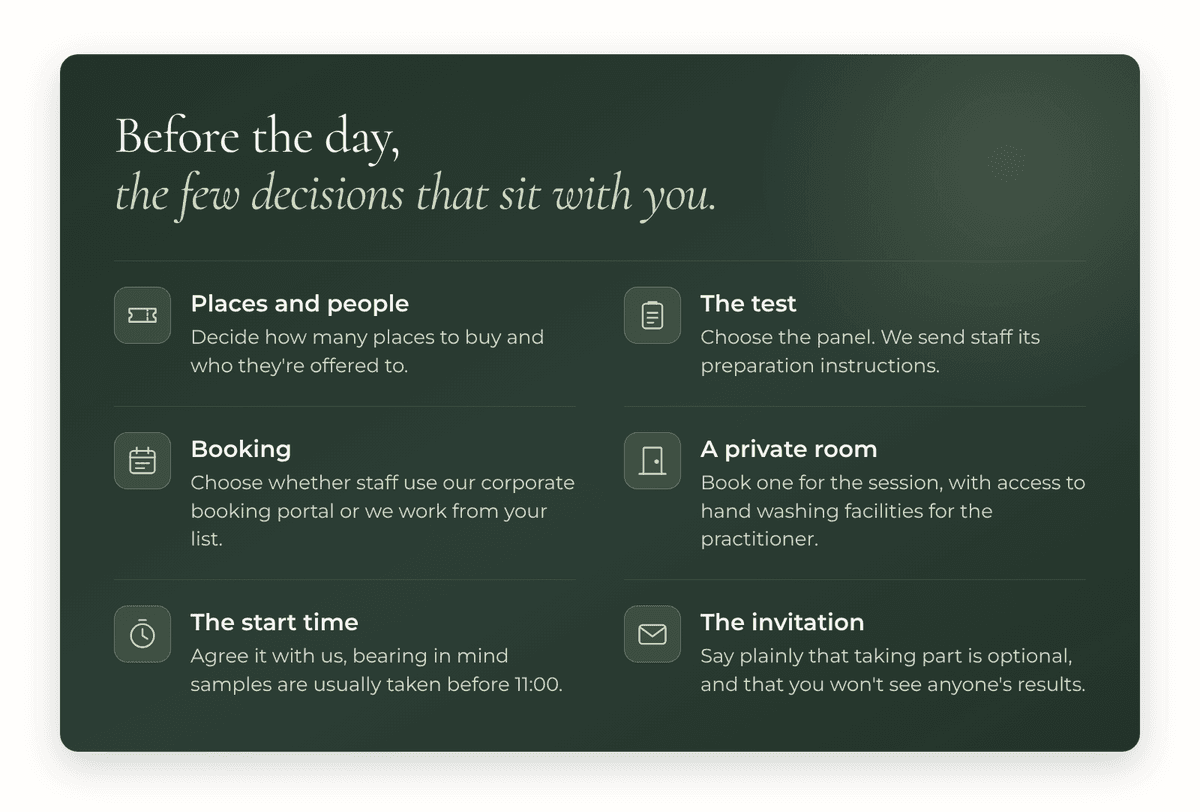
What happens before the day?
The few decisions and the small amount of set up that sit with you.
Before the day, you decide who gets a place and which test they'll have, and you find a room.
Start with the places: you buy a fixed number and choose who receives them. There's no minimum group size, though we recommend at least 20 people. Employers typically choose the Advanced Essential Blood Test, or the Advanced Well Man and Advanced Well Woman Blood Tests. For executives, we can put together a bespoke package.
Staff can then book their own slot through a dedicated corporate booking portal, or, if you'd rather, we work from a list you provide.
On the day, the practitioner needs a private room and access to hand washing facilities. Nothing else is needed from you.
Preparation depends on the test. We send each person their preparation instructions before the day, including whether to fast, and each test's page on our website lists them too. You don't need to send anything yourself. Our article on whether you really need to fast before a blood test covers fasting in more detail.
Places and people
Decide how many places to buy and who they're offered to.
The test
Choose the panel. We send staff its preparation instructions.
Booking
Choose whether staff use our corporate booking portal or we work from your list.
A private room
Book one for the session, with access to hand washing facilities for the practitioner.
The start time
Agree it with us, bearing in mind samples are usually taken before 11:00.
The invitation
Say plainly that taking part is optional, and that you won't see anyone's results.
Why the early finish? There are two practical reasons.
Samples are usually taken before 11:00, partly for sample quality and partly to fit the laboratory's courier times. Tests that include testosterone, such as the Advanced Well Man Blood Test, need a morning sample. UK guidance from the British Society for Sexual Medicine says testosterone levels are highest in the early morning, and recommends measuring it between 7am and 11am.
What happens in each appointment?
About 20 minutes per person: consent, questions, then the blood sample.
Each appointment takes about 20 minutes. The practitioner takes the person's consent, both verbal and written. They answer any questions. Then they take a blood sample from a vein in the arm.
Consent is collected on the day, at the appointment itself. Taking part is always optional for staff.
For anyone who hasn't had blood taken before, the NHS describes it plainly. A small amount of blood is taken with a needle, usually from the inside of the elbow, and a soft strap may go around the arm first. You'll feel a scratch as the needle goes in, which may be a bit uncomfortable. There may be some bruising or swelling afterwards, which should settle after a few days.
From there, samples from the corporate range go to a UKAS accredited laboratory.
If someone misses their slot
If someone is off on the day or misses their appointment, a catch up session or another option is usually available. It depends on where your business is and on our availability, so we arrange it case by case.
When do results come back?
Usually within 24 to 48 hours, checked by our team and sent to each person directly.
Results usually come back within 24 to 48 hours, on screening days as on any other. More complex tests can take longer.
Every result is checked by our team before it's released. Each person then gets a secure email link to their own results portal. There, each result is shown against the laboratory's reference range, which is the range that lab uses to compare results. Alongside the numbers sits an explanation of what each of their markers measures and what it can and can't show.
We handle all communication with staff, from preparation instructions to results, so none of it goes through you. With a person's consent, their results can be shared, for example with their GP or occupational health.
For more on what those results cover, read what a workplace blood test can and can't tell you.
What does the employer get?
A report of anonymised key trends across your workforce, and never anyone's individual results.
You get a report showing anonymised key trends across your workforce. You never see any individual's results.
There's a floor on group size. No group figure is shown for fewer than 5 people, and for small teams we may set a higher minimum, based on our own statistical judgement. Where people have been advised to follow up on a result, the report can say so without identifying anyone.
Privacy has its own article. Who sees your results when your employer pays for screening explains it in full. If you run a smaller business, can a small business offer corporate health screening? covers places and team size.
What staff need to know
A short note you can copy into the invitation to your team.
If you're organising the day, you can forward this part to your team as it stands.
Your employer is offering you a place at an on site health screening. Whether you take it is up to you. If you'd like to, book your slot the way your HR team explains.
Before the day, we'll send you preparation instructions for your test, including whether you need to fast. They're also on your test's page on our website. Keep taking any prescribed medicines as normal.
On the day, the appointment takes about 20 minutes. The practitioner will ask for your consent, answer your questions and take a blood sample from your arm.
Your results come straight to you, through a secure email link to your own results portal, once our team has checked them. Your employer only sees anonymised trends for the group, and every result comes with an explanation of what each marker measures.
Common questions
Short answers to what people search for about on site health screening.
How long does a workplace health check take?
Each appointment takes about 20 minutes. That covers consent, any questions and the blood sample, which is taken from a vein in the arm.
Do I need to fast for a workplace blood test?
It depends on the test. We send each person their preparation instructions before the day, including whether to fast, and each test's page on our website lists them too.
Why are workplace blood tests done in the morning?
With us, samples are usually taken before 11:00, partly for sample quality and partly to fit the laboratory's courier times. For testosterone, UK guidance from the British Society for Sexual Medicine recommends measuring it between 7am and 11am.
Do employees have to take part?
No. Taking part is always optional for staff, and each person gives their consent at their own appointment.
What happens if someone misses their appointment?
A catch up session or another option is usually available. It depends on your location and our availability, and we arrange it case by case.
Is health screening the same as health surveillance?
No. The Health and Safety Executive describes health surveillance as repeated health checks used to identify ill health caused by work, required by law where workers remain exposed to health risks. It says health surveillance is not the same as health screening.
Was this article helpful?
Screening for your team
On-site and clinic health screening, scoped to your organisation.
Book a discovery call
Daniel SnowWritten by · BSc (Hons), PGCE
This article is for general information only and is not medical advice. If you have symptoms or concerns, speak with a qualified clinician.