
A private blood test is one you arrange yourself, rather than one a GP or nurse arranges for you on the NHS. You give a small sample of blood, a laboratory analyses it, and the results come back to you. This guide walks through each step, from choosing a test to reading what comes back.
What's a private blood test?
It's a blood test you arrange yourself, outside the usual NHS route.
On the NHS, a blood test starts with someone else. A GP, nurse or specialist who thinks you need one tells you how to arrange it. The NHS says a blood test may be done to check your general health, to find out whether symptoms are caused by certain conditions, to assess your likelihood of getting a condition, or to see how well a condition is being managed.
A private test starts with you. You pick the test, or your employer arranges one for you, and you don't need a referral. That's the main difference. The rest of the journey, from sample to lab to results, is what this guide covers.
Private testing sits alongside the NHS. It isn't a replacement for it. You can use both: a private test to keep an eye on a few markers, and your GP for your care.
Here's how it works with us, in brief. We serve customers in England. Depending on the test, you can give your sample with a home finger prick kit, at a home visit, or at our clinic in Hull. Results usually come back within 24 to 48 hours, and some more advanced panels take longer. Each person then gets a secure email link to their own results portal.
Who finds them useful?
People come to private testing for all sorts of reasons. A few examples:
Curious about your health
You'd like to know where markers such as blood sugar, cholesterol and vitamin D sit today.
Keeping track
You want to repeat the same test over months and see the trend, rather than rely on one snapshot.
Following something up
A past result was flagged and you'd like to see where it sits now, alongside your GP's care.
Training hard
You exercise a lot and want to read your results with your training in mind.
Through work
Your employer has arranged screening for staff, and taking part is always your choice.
If you've passed 40, our article on the blood tests worth tracking once you turn 40 explains which markers are worth keeping an eye on. If you train hard, why athletes need to read their blood tests differently explains how exercise shows up in a blood test.
What can blood tests check?
One test can look at a single marker or a whole panel covering several parts of the body.
A marker is one thing the lab measures in your blood. Some tests check a single marker. Others, called panels, group many markers together so you get a wider picture in one sample.
Each marker has its own job. Take haemoglobin A1c (HbA1c). It measures your average blood sugar level over the last 2 to 3 months, and you can eat and drink as normal before the test. That makes it a useful example of what a marker is: one number that answers one question.
Our Advanced Essential Blood Test is a good example of a panel. It covers 43 markers in one sample, including:
your blood count
liver markers
kidney markers
HbA1c (average blood sugar)
cholesterol
iron
vitamin B12 and folate
vitamin D
thyroid
You don't need to fast for it, and it's taken as a sample from a vein, at our Hull clinic or at a home visit.
A panel is only as useful as your understanding of each number on it. That's why every set of results we send comes with an explanation of what each marker measures and what it can and can't show.
Our other guides go deeper into specific areas. See men's health and hormones, women's hormonal health and preventative health and biomarkers.
Related test
Advanced Essential Blood Test
A wide 43 marker check without sex hormones, for men and women: full blood count, thyroid, cholesterol, HbA1c, organs, iron, vitamins and hs-CRP.
How is the blood taken?
Depending on the test, the sample comes from a finger prick at home or from a vein.
The NHS describes a standard blood test simply. A healthcare professional uses a needle to take a small amount of blood, usually from the inside of your elbow. Sometimes blood may be taken from your wrist or your finger instead, which is called a finger prick test.
Private tests use the same two basic methods. With us there are three ways to give a sample, depending on the test: a home finger prick kit, a home visit, or an appointment at our Hull clinic. Not every test comes in every form. Some larger panels, including our Advanced Essential and Advanced Well Woman Blood Tests, need a sample from a vein, so they're taken at our Hull clinic or at a home visit.
Finger prick at home
You prick your fingertip and collect a few drops of blood, following the steps in the kit. Then you post the sample back to the lab, as the instructions say. It suits people who'd rather do it at home, at a time that works for them.
From a vein
A sample is taken from a vein, usually on the inside of your elbow, with a needle. This happens at our Hull clinic or at a home visit, whichever suits you. You don't need to collect anything yourself.
Whichever way your blood is taken, a few things can affect the sample. They include the time of day, whether you've eaten, recent exercise, how the blood is collected, the tube used, and how the sample is handled, transported and stored before it reaches the lab. Laboratory specialists say this stage, before the sample is analysed, is where errors in testing are most common.
That's why the instructions with your test matter. They're there to keep your sample in good shape from the moment it leaves you to the moment it's analysed.
Using a finger prick kit? World Health Organization guidance says to wipe away the first drop of blood, because it can contain tissue fluid or debris from the skin. It also says not to squeeze the finger too hard, because that dilutes the sample with tissue fluid and makes red blood cells more likely to break open (called haemolysis).
Who analyses your sample?
An accredited laboratory, checked against an international standard for medical labs.
Your sample goes to a medical laboratory, where each marker is measured. The quality of that lab is one of the most useful things to ask about.
The standard to look for is ISO 15189. It's an international standard that sets out requirements for quality and competence in medical laboratories. In the UK, a lab's accreditation to it is assessed by UKAS, the United Kingdom Accreditation Service. UKAS says accreditation verifies a laboratory's integrity, impartiality and capability. In plain terms, an independent body has checked the lab against a recognised standard.
Accreditation also touches how your results are read. The ISO 15189 standard says each laboratory should regularly re-evaluate its own reference ranges, the "normal" bands printed next to your results. More on those below.
Here's where we stand. Our blood tests are processed by a UKAS accredited laboratory (ISO 15189). Some specialist tests may be referred on to another laboratory.
Accreditation is about the laboratory. It tells you the lab has been assessed against a recognised standard. It's one good question to ask of any provider, alongside the others later in this guide.
How should you prepare?
Follow the instructions for your own test, because different tests ask for different things.
The NHS says whoever arranges your blood test should tell you if you need to do anything to prepare. For a private test, that's the instructions that come with it. They're written for that test, so they come first.
One question comes up a lot: do I need to fast? Before some tests you may need to have nothing to eat or drink except water for a short time. A fasting blood glucose test is one of them: it needs at least 8 hours beforehand, drinking only water. For most people, though, fasting isn't needed before a cholesterol test. And HbA1c doesn't need it at all.
Timing matters for some hormones too. Testosterone is highest in the early morning, so UK guidance from the British Society for Sexual Medicine says it should be measured between 7am and 11am, ideally fasting. Our Advanced Well Man Blood Test instructions match this: a sample in the morning, between 7am and 11am, before you eat.
Depending on the test, its instructions may also ask you to:
Pause biotin
Stop biotin (vitamin B7, often found in hair, skin and nail supplements) for 48 hours before your sample.
Rest from hard exercise
Avoid hard exercise for 48 hours beforehand.
Skip alcohol
Avoid alcohol for 24 hours beforehand.
Hold iron supplements
Don't take iron supplements for 24 hours beforehand.
Keep taking prescribed medicines
Carry on with any medicine you've been prescribed, unless your doctor tells you otherwise.
For the full detail on food and drink, see do you really need to fast before a blood test?
Related test
Advanced Well Man Blood Test
A 44 marker men's check of cholesterol, liver, kidneys, blood sugar, full thyroid, iron, vitamins, inflammation and testosterone, for a thorough baseline.
Reading your results
Each result sits next to the lab's reference range, and a flag is a prompt to look closer.
With us, your results arrive through a secure email link to your own results portal. Every result is checked by our team before it's released. Your explanation covers what each of your markers measures and what it can and can't show.
Next to most results you'll see a reference range. It's the band the lab uses to decide whether a result is flagged as high or low. Knowing how that band is made changes how you read it.
How a reference range is made
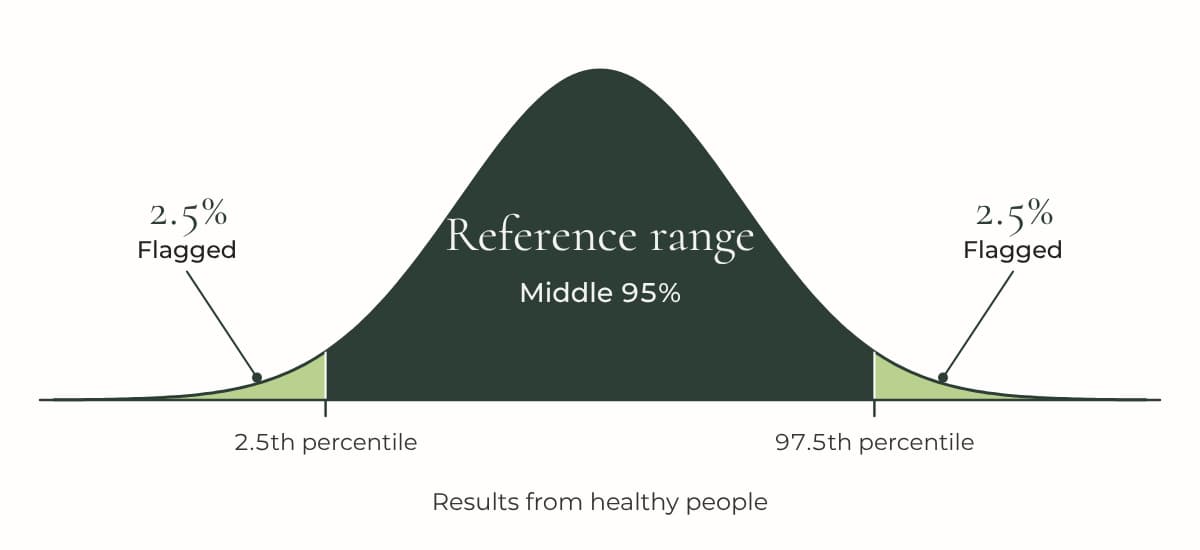
A lab's reference range usually covers the middle 95% of results from a group of healthy people. The bottom of the range sits at the 2.5th percentile and the top at the 97.5th. So 5% of results from healthy people, about 1 in 20, fall outside the range for that test and get flagged, even though nothing is wrong.
Middle 95%
of results from healthy people is what a lab's reference range usually covers
1 in 20
results from healthy people fall outside the range for that test
The more markers there are on a panel, the more chances there are for one to land just outside its range. A flag is a prompt to look more closely at that marker.
Some results use set cut-offs
A few tests work differently. Some results are read against fixed cut-offs set for a medical decision, rather than against the lab's 95% range. HbA1c is one. The NHS says a result of 42 to 47 mmol/mol means you may be at risk of getting diabetes (sometimes called pre-diabetes), and 48 mmol/mol or above means you may have diabetes.
Ranges differ between labs
Reference ranges can differ from one lab to another, because labs use different methods and check their ranges against their own populations. So read each result against the range printed on your own report. When you track a marker over time, compare like with like, ideally from the same lab.
One result is a snapshot
Results can vary a little between tests, partly naturally and partly because of the lab method. For example, NICE notes that creatinine, a kidney marker, can vary by about 5% between tests. It advises that a first eGFR below 60 (eGFR is the kidney filtering estimate worked out from creatinine) should be confirmed by repeating the test within 2 weeks. So repeating a test is a normal step in reading results.
A result on its own isn't a diagnosis, so if yours is outside the range, take it to your GP. You can share your results with them, and your GP may repeat a test. For more on what a single panel can show, read what a workplace blood test can and can't tell you.
If you feel unwell or have symptoms, speak to your GP rather than waiting for a test result.
Choosing a provider
A few practical questions help you compare providers and know what you're getting.
Private blood testing comes in many shapes, so it helps to know what to ask. These questions are a good start. They aren't the only ones worth asking, but each tells you something useful about the service behind the test.
Which lab analyses it
Ask whether the laboratory is accredited to ISO 15189 by UKAS.
Which markers are included
Look for a full list of markers on the test page before you choose.
How the sample is taken
Check whether that test uses a finger prick kit, a home visit or a clinic appointment.
Who checks the results
Ask whether results are checked before release and explained to you.
How you get your results
Ask how results reach you and how long they usually take.
Here's how we answer them. Our tests go to a UKAS accredited laboratory (ISO 15189). Depending on the test, you can use a home finger prick kit, have a home visit, or come to our Hull clinic. Results are checked by our team and come with an explanation of each marker. They reach you through a secure email link to your own portal, usually within 24 to 48 hours, with some more advanced panels taking longer.
Testing through your employer
Some employers arrange blood testing for staff, with each person's results kept private.
Not everyone arranges a test themselves. Some employers bring screening into the workplace, so staff can take part at work.
Smaller firms are less likely to offer it. A CIPD survey of UK employers found that 23% of private sector small and medium firms (2 to 249 staff) offer health screening to all employees, compared with 47% of large private sector organisations.
Here's how a workplace screening day works with us:
Your employer arranges a day
They choose the tests, typically the Advanced Essential or the Advanced Well Man and Advanced Well Woman Blood Tests.
You decide whether to take part
Taking part is always optional for staff.
Your appointment
It typically takes about 20 minutes, with a sample taken from a vein in your arm.
Your results come to you
Each result is checked by our team, and you get your own results and explanation.
Your employer sees group data only
They never see your results, only anonymised, group level data.
Whether you need to fast depends on the panel your employer chooses. With your consent, your results can be shared, for example with your GP or occupational health. There's no minimum group size, though we recommend at least 20 people, and bespoke packages can be created for executives.
If you're an employer weighing this up, read five questions to ask when choosing workplace health checks, small firms and staff health: the provision gap in numbers and our corporate wellbeing and executive health screening guide.
Common questions
Quick answers to the questions people ask most about private blood tests.
Can I get a blood test without a GP referral?
Yes. A private blood test is one you arrange yourself, so you don't need a referral. On the NHS, a GP, nurse or specialist who thinks you need a test tells you how to arrange it.
Will my GP accept private blood test results?
You can share your private results with your GP, and your GP may repeat a test. That's normal: results can vary a little from one test to the next.
How long do private blood test results take?
With us, results usually come back within 24 to 48 hours. Some more advanced panels take longer. You get them through a secure email link to your own results portal.
Are finger prick blood tests accurate?
Accuracy depends on how the sample is collected, handled and transported, and on the lab that analyses it. With a finger prick kit, follow the steps closely: wipe away the first drop and don't squeeze too hard. Look for a lab accredited to ISO 15189.
Do I need to fast before a blood test?
Only for some tests. A fasting glucose test needs at least 8 hours with only water. Most people don't need to fast for a cholesterol test. Always follow the instructions for your own test.
What does it mean if my result is outside the range?
It means your result sits outside the band that the middle 95% of healthy people's results fall in. About 1 in 20 results from healthy people land outside it for any one test. Your explanation sets out what that marker measures and what it can and can't show, and every result is checked by our team before it's released.
Know where you stand
Home finger-prick kits, nurse visits and clinic appointments, with your results explained.
Browse all tests
Daniel SnowWritten by · BSc (Hons), PGCE
This guide is for general information only and is not medical advice. If you have symptoms or concerns, speak with a qualified clinician.