
A general men's health blood test checks the basics: your blood count, kidneys, liver, cholesterol, blood sugar (HbA1c), thyroid, iron and vitamins. Hormone tests such as testosterone are added when there's a reason, such as low sex drive or erection problems, which UK guidance calls the symptoms most suggestive of low testosterone . PSA, the prostate test, is a choice to weigh up first, because the UK does not recommend screening every man for prostate cancer .
Which blood tests matter for men?
The core markers in a general men's blood test, and what each one looks at.
A general panel checks several of the body's main systems from one sample.
Blood count
Counts your red cells, white cells and platelets.
Kidneys
Creatinine is a waste product from your muscles, and eGFR uses it to estimate how well your kidneys filter your blood .
Liver
ALT and GGT are enzymes, and a raised level can be a sign that the liver is under strain .
Cholesterol
Includes HDL, often called "good" cholesterol, and non HDL, often called "bad" cholesterol .
Blood sugar
HbA1c shows your average blood sugar over the last 2 to 3 months .
Thyroid
TSH and thyroxine (T4) are the blood tests used to check for an underactive thyroid .
Iron
British Society of Gastroenterology guidance calls ferritin the single most useful marker of iron deficiency anaemia .
Vitamin D
Helps keep bones, teeth and muscles healthy .
Hormones come in when there's a reason to look. UK guidance says men with erection problems should have their testosterone measured . One NHS guide for GPs goes further and suggests HbA1c, a cholesterol profile and an early morning testosterone as first tests, because erection problems can be a marker of heart disease .
Turned 40? See the blood tests worth tracking once you turn 40.
Our Advanced Well Man Blood Test covers every marker above, plus total testosterone. It doesn't include SHBG, PSA, ApoB or Lp(a), which are explained below.
Related test
Advanced Well Man Blood Test
A 44 marker men's check of cholesterol, liver, kidneys, blood sugar, full thyroid, iron, vitamins, inflammation and testosterone, for a thorough baseline.
How do male hormones work?
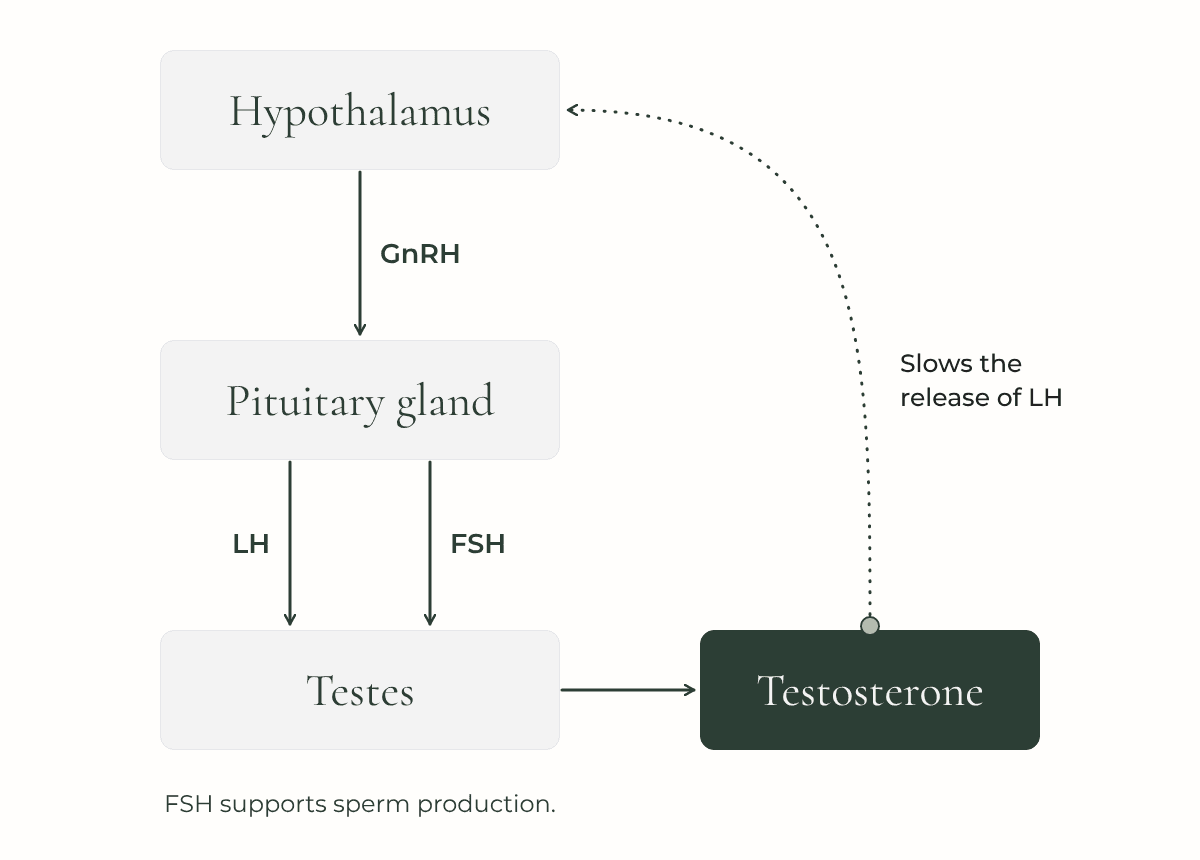
The brain, the pituitary gland and the testes work as a loop, with testosterone feeding back to the brain.
Testosterone is made in the testes, but the instruction to make it starts in the brain. A part of the brain called the hypothalamus releases a hormone called GnRH. That tells the pituitary gland to make two messenger hormones, luteinising hormone (LH) and follicle stimulating hormone (FSH) .
LH tells the testes to make testosterone. FSH supports sperm production. As testosterone rises, it feeds back to the brain and slows the release of LH . It works a bit like a thermostat: when there's enough, the signal to make more is turned down.
That loop is why LH and FSH are worth measuring alongside testosterone. In men with low testosterone, they help show whether the problem starts in the testes or further up, in the pituitary gland or the hypothalamus .
What does testosterone do?
UK guidance lists testosterone's effects as including sex drive, erections, muscle mass and strength, bone density, red blood cell production and sperm production . In the kidneys, testosterone promotes the making of red blood cells . UK and US guidelines include blood checks for men treated with testosterone, which we come back to below .
Is my testosterone low?
Symptoms give clues, but low testosterone is confirmed with repeat morning tests and symptoms together.
Symptoms alone can't tell you. UK guidance says the symptoms most suggestive of low testosterone are sexual: low sex drive, fewer morning erections and erection problems, especially when they come together. Tiredness, poor sleep, low mood and loss of strength are common too, but less specific .
Many of those symptoms have several possible causes and also come with normal ageing, so they can appear in men whose testosterone is normal . The NHS lists lack of sleep, poor diet, lack of exercise, too much alcohol, smoking, stress, depression and anxiety as common causes of these symptoms in men .
Do men go through a menopause?
Not in the way women do. The NHS calls "male menopause" an unhelpful term, because it suggests a sudden drop in testosterone in middle age. In fact, testosterone declines steadily, at about 1% a year from around the age of 30 to 40, and the NHS says this is unlikely to cause any problems in itself .
What some men do develop is a condition called late onset hypogonadism. The NHS describes it as uncommon and not a normal part of ageing, and says it's more likely in men who are obese or have type 2 diabetes .
In the European Male Ageing Study of over 3,000 men aged 40 to 79, testosterone deficiency, defined strictly as low levels plus at least three sexual symptoms, affected 2.1% overall. That rose from 0.1% of men in their 40s to 5.1% of men in their 70s . UK guidance says most men keep normal testosterone into old age, and links the higher rates in older men mainly to obesity, type 2 diabetes and long term illness .
UK guidance also links low testosterone to chronic kidney disease, and to some medicines, including opiates, anabolic steroids and some medicines for epilepsy and mental illness .
2.1%
of men aged 40 to 79 had testosterone deficiency in a large European study
2
morning tests to confirm a low result, preferably 4 weeks apart
7am to 11am
the testing window UK guidance recommends
How is low testosterone confirmed?
UK guidance says low testosterone should be confirmed on at least 2 morning tests, preferably 4 weeks apart and, if possible, not during an acute illness. The guidance also says testosterone deficiency needs typical symptoms as well as low levels .
UK guidance advises measuring LH and FSH when total testosterone is below 12 nmol/L. That figure is the guideline's point for further tests, not a normal range, and labs vary in how they test testosterone . A raised LH alongside low testosterone points to the testes not working fully. Low LH and FSH point towards the pituitary gland or the hypothalamus, which may need further tests. When LH and FSH are both low, the guidance says prolactin should be measured too .
Getting the timing right
Testosterone is highest in the early morning, so UK guidance says to test between 7am and 11am, ideally fasting. In healthy volunteers, fasting levels were up to 30% higher than levels after eating, though the guidance doesn't insist on fasting for people who don't normally fast .
Pick a morning slot
Test between 7am and 11am, when testosterone is highest.
Fast if you can
Fasting is ideal, but UK guidance doesn't insist on it.
Wait out an illness
If possible, avoid testing during an acute illness.
For other tests, see do you really need to fast before a blood test?
Our Male Hormone Profile includes total and calculated free testosterone, SHBG, albumin, LH, FSH, oestradiol and prolactin, so the whole loop is read together.
Related test
Male Hormone Profile
10 markers for men noticing changes in energy, mood or drive: total and free testosterone, SHBG, LH, FSH, prolactin, oestradiol and DHEA sulphate.
Base price. Clinic appointments cost extra.
Total testosterone, free testosterone and SHBG
Your report may show three testosterone numbers, and each one answers a different question.
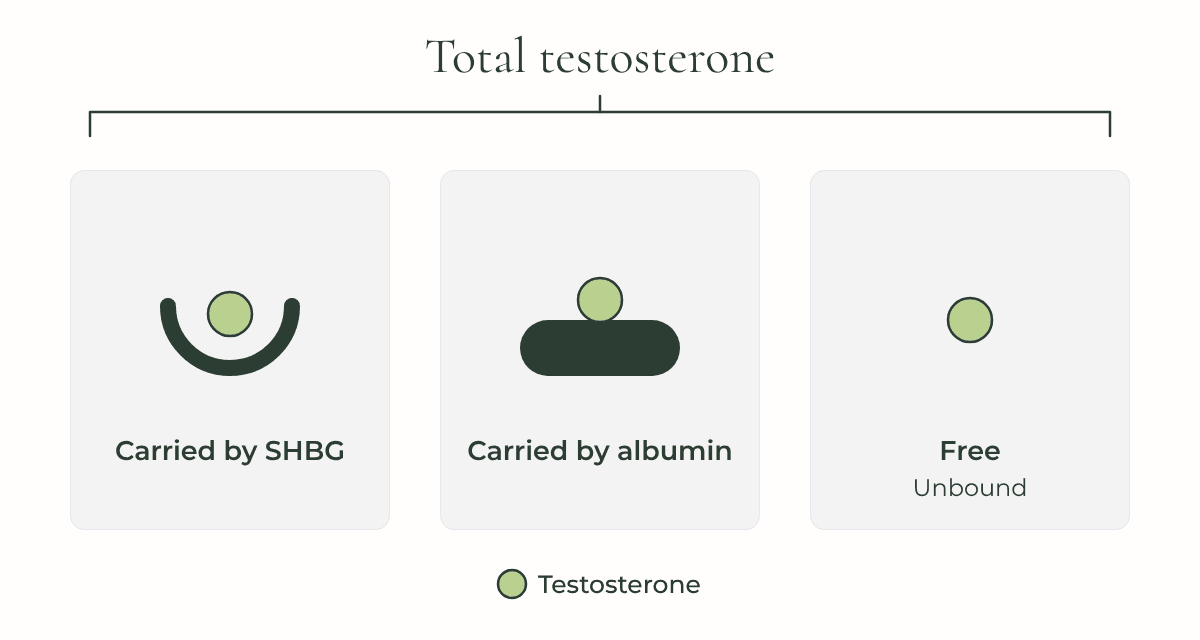
Testosterone travels in your blood in two ways. Some is carried by proteins, mainly sex hormone binding globulin (SHBG) and albumin, and some is unbound, which is called free testosterone. Total testosterone measures both .
SHBG is the protein that carries testosterone and other sex hormones around your blood. The widely used view is that only the free hormone acts on the body's tissues, though scientists still debate this .
Calculated free testosterone isn't measured directly. It's worked out from your total testosterone, SHBG and albumin results using a formula. UK guidance recommends this calculated method, and says some direct free testosterone tests give unpredictable results .
Total testosterone
All the testosterone in your blood, both the part carried by proteins and the free part.
Calculated free testosterone
The unbound part, worked out from total testosterone, SHBG and albumin.
Why does SHBG matter? It tends to rise with age, which lowers free testosterone. UK guidance suggests checking SHBG when total testosterone is borderline or low normal, especially in older men and men with obesity .
Oestradiol, prolactin and thyroid
Three other hormones that can affect how men feel, and why each one is checked.
Three other hormones can explain some of the same symptoms as low testosterone.
Oestradiol
The strongest of the natural oestrogens. Men make it too, in much smaller amounts, by converting testosterone .
Prolactin
A hormone made mainly by the pituitary gland. High levels can cause symptoms of low testosterone in men .
Thyroid (TSH and T4)
Blood tests that check for an underactive thyroid, which can cause tiredness, weight gain and low mood .
In men, oestradiol can be slightly raised in conditions such as liver disease and obesity. Higher oestradiol in men can be linked to sexual problems, lower fertility and extra breast tissue .
Causes of high prolactin include some medicines, a benign growth on the pituitary gland called a prolactinoma, and an underactive thyroid .
Anyone can get an underactive thyroid, though the main UK cause is most common in women . Tiredness and low mood appear on both the underactive thyroid list and the low testosterone list .
Heart and blood sugar markers
Cholesterol, ApoB, Lp(a) and HbA1c each add a different piece to the heart and blood sugar picture.
A standard cholesterol test gives you several numbers. HDL is often called "good" cholesterol. Non HDL cholesterol is worked out from your total and HDL results, and is often called "bad" cholesterol . NICE doesn't require a fasting sample for a standard cholesterol test .
Cholesterol is one part of heart risk. NICE uses a tool called QRISK3 to estimate your 10 year risk from several factors, and a GP looks at cholesterol alongside things like age, blood pressure and health conditions .
ApoB and Lp(a)
Apolipoprotein B (ApoB) is another marker that can be measured alongside cholesterol. A 2025 review of 15 studies, covering 593,354 people, found ApoB predicted heart disease risk better than LDL cholesterol in all 9 studies that compared them, and better than non HDL cholesterol in 7 studies . The authors recommend it as the main measure. That's their view, not UK guidance.
Lipoprotein(a), or Lp(a), is a particle similar to LDL with an extra protein attached . It's mainly inherited and stays fairly stable through life, so HEART UK says it usually only needs measuring once . A European Atherosclerosis Society panel recommends testing it at least once in adults . A raised Lp(a) is linked with a higher risk of heart and circulatory disease , and HEART UK notes it's currently not routinely measured in general practice .
HbA1c and blood sugar
HbA1c measures your average blood sugar over the last 2 to 3 months, and you can eat and drink as normal before the test . As a guide, the NHS uses these bands :
HbA1c result | What the NHS says, as a guide |
|---|---|
42 to 47 mmol/mol | You may be at risk of getting diabetes (sometimes called prediabetes) |
48 mmol/mol or above | You may have diabetes |
A single raised result is followed up. The WHO says that in someone without symptoms, at least one more HbA1c or blood glucose result in the diabetic range is needed before diabetes is confirmed .
Should men have a PSA test?
Who PSA testing is recommended for, what a result can and can't show, and how to prepare.
PSA testing is recommended for one higher risk group. The UK National Screening Committee recommends targeted screening, with a PSA test every 2 years, for men aged 45 to 61 who have a BRCA2 gene variant and a family history of breast, ovarian, pancreatic or prostate cancer .
A PSA test checks the level of prostate specific antigen in your blood . PSA is a protein made by cells in the prostate gland .
Following a review in March 2026, the committee does not recommend screening everyone for prostate cancer, because it says screening is more likely to cause more harm than good across the whole population . Routine PSA testing isn't offered on the NHS unless genetic tests show a faulty BRCA2 gene, but any man can ask a GP about PSA testing .
Two things are worth knowing before you decide. A high PSA doesn't mean you have cancer: it may be raised for other reasons, such as an enlarged prostate . And a normal PSA doesn't rule prostate cancer out . If you choose to test, a few everyday things can raise PSA, so preparation matters .
No ejaculation or anal sex
Avoid both for 48 hours before the test, as they can raise PSA.
No hard exercise
Skip anything that leaves you out of breath for 48 hours beforehand.
No cycling
Don't ride a bike for 48 hours before the test.
Clear any urine infection first
Wait 4 to 6 weeks after the infection has cleared.
Eat as usual
You can eat and drink normally before a PSA test.
Related test
PSA Blood Test
A single marker test for PSA, the protein made by the prostate gland, for men who want to know their level and follow it over the years.
Base price. Clinic appointments cost extra.
Monitoring during testosterone treatment
What UK guidance checks before and during prescribed testosterone treatment, and why each check matters.
This section is for men already prescribed testosterone treatment, often called testosterone replacement therapy, and anyone curious about how it's monitored. UK guidance from the British Society for Sexual Medicine (BSSM) recommends blood checks before it starts and at set points afterwards .
Before starting
A blood count, a prostate assessment (ideally with a PSA test), a breast check and a heart risk assessment.
At 3 months
A first review of testosterone level, symptoms, haematocrit and PSA.
At 6 to 12 months
A second review of the same checks.
Every year
Ongoing yearly reviews of the same checks.
That schedule comes from the BSSM guideline . Local NHS protocols can differ .
Testosterone level
Testosterone is monitored with total testosterone, SHBG and albumin, so free testosterone can be calculated .
Haematocrit
Haematocrit is the share of your blood made up of red blood cells. It's watched because testosterone can raise red blood cell levels . UK and US guidelines both set a haematocrit level above which treatment isn't started, but the level differs between guidelines and local NHS protocols .
PSA
PSA rises a little early in treatment. So UK guidance uses the PSA at 6 months as the new starting point, with yearly checks after that .
Cholesterol, blood sugar and liver
UK guidance says cholesterol and blood sugar checks aren't needed for safety during treatment, though they may be used to keep track of other aspects of health . Some NHS protocols also include liver function tests .
Fertility
Treatment changes the hormone loop too. UK guidance says testosterone treatment lowers LH and FSH and, in younger men, often reduces fertility after 6 to 12 months. Fertility recovers in 60% to 70% of men within 12 months of stopping .
Our Testosterone Therapy Monitoring test can be taken by any man, including men on testosterone treatment. It covers the guideline's core markers: total and calculated free testosterone, SHBG, albumin, a full blood count including haematocrit, and PSA. It's a monitoring panel, not a way to start treatment, and it's taken at our Hull clinic or at a home visit. For wider checks, the Advanced TRT Blood Test adds cholesterol, HbA1c, thyroid and kidney markers.
Related test
Testosterone Therapy Monitoring
30 markers covering hormones, a full blood count with haematocrit, liver function and PSA, for men on testosterone therapy and any man who wants them.
Men who use anabolic steroids
What anabolic steroids can affect in the body, and the help and support available.
The NHS describes anabolic steroids as prescription only medicines that are sometimes taken without medical advice to build muscle . If you use them, or someone close to you does, here's what they can affect and who can help.
What steroids can affect
The NHS lists effects in men including reduced sperm count, infertility, shrunken testicles, erection problems, breast development and severe acne. In anyone, they can cause high blood pressure, high cholesterol, heart attack or stroke, and liver or kidney problems .
A review of a Dutch group of men who used steroids reports effects on blood pressure, haematocrit, cholesterol and heart structure, and to a limited extent on liver and kidney function .
Steroids also affect the hormone loop. In a Dutch study of 100 men who used anabolic steroids, their own testosterone production stopped during use. Three months after stopping, average testosterone was back to its starting level, but sperm counts took about a year to recover, and 11% still had low testosterone a year after their steroid use began . So hormone results taken during or after steroid use can look very different from usual.
Help and support
The NHS warns that sharing needles carries a risk of hepatitis B, hepatitis C and HIV . Help is available from several places:
Your GP. The NHS advises seeing a GP if you think you're addicted to steroids .
FRANK. The NHS points people to the FRANK website for information and support .
Needle and syringe services. NICE recommends that services used by people who inject image and performance enhancing drugs offer specialist advice, including on side effects, and referral to specialist clinics where they exist .
Specialist support services. Public Health England guidance (2014) gave the example of a specialist clinic in Manchester that offered a basic health screen, including blood, hormone and blood borne virus tests, and pointed people to their own GP about any findings .
Can sleep and weight change testosterone?
What the evidence shows about sleep, weight loss and testosterone, and how far it goes.
One research paper notes that most of men's daily testosterone release happens during sleep . In that small study, 10 healthy young men who slept 5 hours a night for one week had daytime testosterone 10% to 15% lower . That was 10 men over one week, so it doesn't show what happens in older men or over months.
UK guidance reports that weight loss can raise testosterone in men with obesity. In one study, 68 men who lost about 10 kg over a year saw their total and free testosterone rise. Another large study found a 20% drop in BMI was needed for a clear rise in free testosterone .
If you train hard, some results read differently. NICE says eGFR, the kidney marker, should be read with caution in people with very high muscle mass, such as bodybuilders, because more muscle can make eGFR look lower than it really is . Our article on why athletes need to read their blood tests differently covers more of these.
How testing with us works
How a blood test with The Livewell Syndicate works, from sample to results.
You can choose a home finger prick kit, a home visit or an appointment at our clinic in Hull. We serve customers in England. The testosterone treatment panels need a sample from a vein, so they're taken at our Hull clinic or at a home visit.
Our tests are processed by a UKAS accredited laboratory (ISO 15189). Results usually come back within 24 to 48 hours, though some advanced panels take longer. They arrive through a secure email link to your own results portal.
Each result sits beside your lab's reference range. Labs set their own ranges, so always compare a result with the range printed next to it . Your explanation covers what each of your markers measures and what it can and can't show.
If a result comes back outside your lab's range, or symptoms such as low sex drive or erection problems don't go away, take it to your GP. A result on its own isn't a diagnosis.
Common questions
Quick answers to what men ask most about blood tests and testosterone.
What is a normal testosterone level for a man?
There isn't one number that applies everywhere. Labs vary in how they test testosterone, so ranges differ, and your result is read against your own lab's range .
Can I get a testosterone test on the NHS?
The NHS says a GP may arrange a blood test to measure your testosterone . UK guidance also says men with erection problems should have their testosterone measured .
What blood tests should men get after 40?
In England, adults aged 40 to 74 without certain conditions, such as heart disease or diabetes, should be invited to an NHS Health Check every 5 years. It includes a blood pressure test, a cholesterol test and possibly a blood sugar test .
How often are bloods checked on TRT?
UK guidance recommends reviews at 3 months, at 6 to 12 months, then every year, checking testosterone level, symptoms, haematocrit and PSA . Local NHS schedules can vary .
How long do blood test results take?
Results usually come back within 24 to 48 hours, though some advanced panels take longer. Every result is checked by our team before it's released.
Know where you stand
Home finger-prick kits, nurse visits and clinic appointments, with your results explained.
Browse all tests
Daniel SnowWritten by · BSc (Hons), PGCE
This guide is for general information only and is not medical advice. If you have symptoms or concerns, speak with a qualified clinician.