
The blood tests most worth having for preventative health cover your heart and cholesterol, blood sugar, kidneys, liver, iron and vitamins, thyroid and blood count. Taken while you feel well, they give you a baseline: a set of results that later ones can be judged against . Each result is read against the lab's reference range, which is built from results in healthy people .
What is preventative blood testing?
A set of blood tests taken while you feel well, so you have a baseline to compare against.
Preventative blood testing means checking a set of markers while you feel well, rather than waiting until something feels wrong. A marker is simply something in your blood that a lab can measure, such as cholesterol, iron or vitamin D.
When you have several earlier results, they can act as your own reference, a baseline that later results are judged against .
Hormones have their own pages: our men's health guide and women's health guide. Our guide to private diagnostics explains how private testing works, and the blood tests worth tracking once you turn 40 looks at midlife.
What's in the NHS Health Check?
Who the NHS check is for, what it measures, and how a wider panel adds to it.
The NHS Health Check is for adults in England aged 40 to 74 who don't already have certain conditions, such as heart disease, diabetes, stroke or high blood pressure. You should be invited by your GP or local council every 5 years .
It includes a cholesterol test and possibly a blood sugar test. It also gives your risk of a heart or circulation problem over the next 10 years, such as heart disease, stroke, type 2 diabetes or kidney disease . It's free, and worth taking up when you're invited.
A wider blood panel adds to it, with markers the NHS Health Check page doesn't list, such as kidney, liver, thyroid, iron and vitamin tests .
NHS Health Check
Every 5 years for adults in England aged 40 to 74 without certain conditions. A cholesterol test, possibly a blood sugar test, and a 10 year risk score.
Advanced Well Man or Advanced Well Woman Blood Test
Cholesterol and HbA1c, plus kidney, liver, iron, vitamin and thyroid markers, a full blood count and hs-CRP.
How do you read a result?
What the range beside your result means, and why your own earlier results matter.
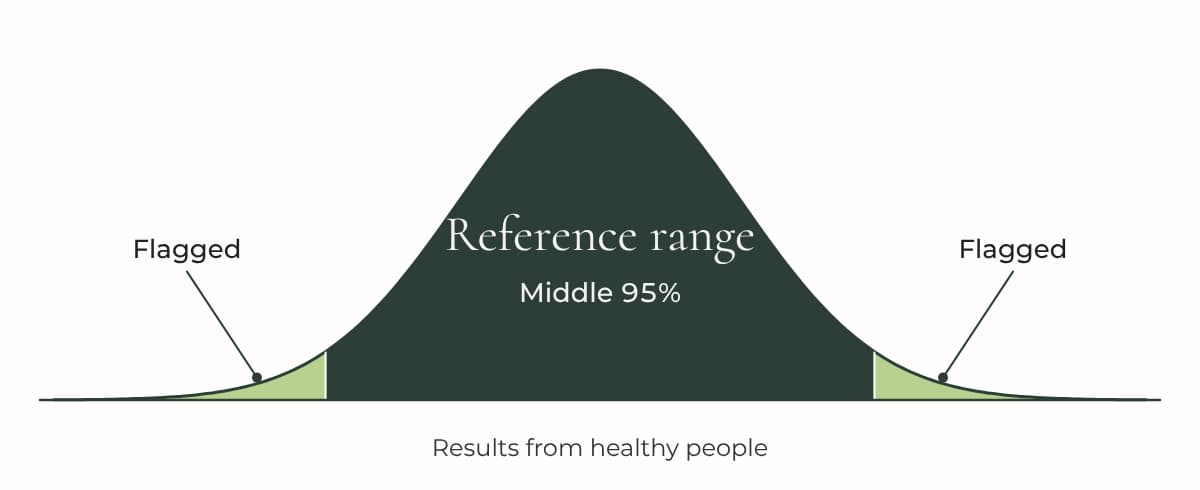
Every result on a report sits beside a range. That range is usually set to cover the middle 95% of results from a group of healthy people . So about 5 in every 100 results from healthy people fall outside it and get flagged .
That happens for each marker separately. So the more markers a panel has, the more likely it is that one healthy result sits just outside its range. A flag is a prompt to look closer, rather than a verdict.
Ranges are worked out for a defined group of people, and guidance says they should be split at least by age and sex. Labs using different methods can have different ranges . For example, one NHS laboratory gives adult haemoglobin ranges of 130 to 180 g/L for men and 115 to 165 g/L for women . That's one lab's range, so it's your own lab's range that counts.
Some numbers you'll come across are clinical decision limits instead: thresholds set for a particular medical decision, such as in cholesterol guidance . The NHS HbA1c figures later on are one example, so we always say whose number it is.
Why your own results matter
Results wobble a little from one test to the next. Laboratory scientists use a person's earlier results to judge whether a difference is bigger than that normal wobble .
A small study followed 43 healthy adults in China, with a blood test every year for six years. Each person's results stayed within a much narrower band than the population range for most common markers . So one result is a snapshot. It can sit inside the range and still be a real change for you.
Heart and cholesterol
What a cholesterol test measures, and where ApoB and Lp(a) fit in.
In England and Wales in 2024, ischaemic heart diseases, where the heart muscle gets too little blood, caused 9.6% of all deaths, second only to dementia and Alzheimer's disease .
54,097
deaths from ischaemic heart diseases in England and Wales in 2024
70% to over 90%
how much of your Lp(a) level is set by your genes, says HEART UK
The standard cholesterol test
A standard cholesterol test, or lipid profile, reports several numbers. HDL is often called "good cholesterol". Non HDL cholesterol is worked out from your total cholesterol and HDL, and is often called "bad cholesterol" . Triglycerides are another type of fat in the blood, and they're linked to heart disease .
LDL stands for low density lipoprotein. A European expert panel looked at studies involving more than 2 million people. It concluded that LDL causes the fatty build up in the arteries that leads to heart attacks and strokes. The risk grows the higher the level, and appears to grow the longer it lasts .
In a standard NHS lipid profile, LDL cholesterol is often calculated from other results rather than measured directly . Higher isn't always better for HDL. HEART UK says very high HDL levels may not give extra protection .
Your GP looks at cholesterol alongside things like your age, blood pressure and health conditions. NICE uses a tool called QRISK3 to estimate your 10 year risk from several factors .
What ApoB adds
Apolipoprotein B (ApoB) is a protein found on the particles that carry cholesterol into artery walls. Each of these particles, including LDL and Lp(a), carries one ApoB . So an ApoB result reflects the number of particles, while LDL cholesterol measures the cholesterol they carry .
Think of lorries on a motorway. ApoB tells you roughly how many lorries there are. LDL cholesterol tells you how much cargo they're carrying.
A 2025 review of 15 studies, with 593,354 people in total, looked at groups where ApoB and cholesterol pointed different ways. ApoB was the better guide to risk than LDL cholesterol in all 9 studies that compared them. Against non HDL cholesterol it did better in 7, with 1 tie and 1 the other way . The authors concluded that ApoB is a more accurate marker of heart and circulatory disease risk .
In the UK, NICE still sets treatment goals using non HDL cholesterol . So ApoB is extra information that sits alongside the standard test.
Lp(a), the one to test once
Lipoprotein(a), or Lp(a), is a particle similar to LDL with an extra protein attached . HEART UK, the cholesterol charity, puts genetic control of your level at 70% to more than 90%. Levels stay fairly stable through life. So HEART UK says Lp(a) usually only needs measuring once, unless another cause is suspected or specific treatment is started . A European Atherosclerosis Society panel recommends testing it at least once in adults .
A raised Lp(a) is linked with a higher risk of heart and circulatory disease, and of narrowing of the aortic valve in the heart . HEART UK says standard risk calculators may underestimate risk in people with raised Lp(a) . It isn't in every panel, so look for it by name on the marker list.
Related test
Advanced Heart Health Profile
Full cholesterol plus ApoB, ApoA1, Lp(a), hs-CRP and Lp-PLA2: 11 heart markers for people who want to look well beyond a standard cholesterol test.
Blood sugar and insulin
What HbA1c shows, how the NHS reads it, and where insulin tests fit.
Haemoglobin A1c (HbA1c) measures your average blood sugar (glucose) level over the last 2 to 3 months. You can eat and drink as normal before the test .
The NHS gives these figures as a guide .
HbA1c result | What the NHS says |
|---|---|
42 to 47 mmol/mol | You may be at risk of getting diabetes (sometimes called pre-diabetes) |
48 mmol/mol or above | You may have diabetes |
The World Health Organization says diabetes shouldn't be confirmed from one raised result in someone without symptoms. At least one more HbA1c or blood glucose result in the diabetic range is needed . The NHS also says HbA1c results can sometimes be affected by other conditions or medicines .
Fasting insulin and HOMA-IR
HOMA-IR stands for homeostasis model assessment of insulin resistance. It estimates insulin resistance from a single fasting sample of glucose and insulin . Its designers say it suits studies of large groups, and that results need careful interpretation .
Insulin results can also differ between labs. In a 2009 comparison of 10 commercial insulin tests, 7 differed from a reference method by more than 15.5% in 36% to 100% of samples . That's why an insulin result is read against your own lab's range, and why we don't quote a single HOMA-IR cut off.
So why look at insulin at all? A UK study followed 6,538 civil servants without diabetes for a median of 9.7 years. Of these, 505 developed type 2 diabetes. In those 505 people, on average, insulin sensitivity (estimated by HOMA) fell steeply in the 5 years before their diabetes was confirmed. Fasting glucose rose steeply from about 3 years before . These are group averages, so they can't predict one person's future. They do show why researchers watch these markers.
The Insulin Resistance Check needs an 8 to 12 hour fast. For other tests, see our article on whether you really need to fast before a blood test.
Related test
Insulin Resistance Check
Glucose, insulin and a HOMA-IR score worked out from both: 3 markers that show how hard your body is working to keep blood sugar steady.
Kidneys, liver and inflammation
What creatinine, eGFR, the liver markers and hs-CRP measure, and what can nudge them.
The Advanced Well Man and Advanced Well Woman Blood Tests include all the markers in this section.
Kidneys
Creatinine is a waste product made from creatine, which your muscles use for energy. Estimated glomerular filtration rate (eGFR) estimates how well your kidneys filter your blood. It's worked out from creatinine using a formula .
Because creatinine depends partly on muscle, NICE says eGFR should be read with caution in people with very high or very low muscle mass. More muscle can make eGFR look lower than it really is. NICE also advises adults not to eat any meat in the 12 hours before an eGFR blood test . If you lift, our article on why athletes need to read their blood tests differently goes further.
NICE asks for a first eGFR below 60 ml/min/1.73 m² to be confirmed with a repeat test within 2 weeks. It also reminds clinicians that creatinine results can vary by about 5% between tests . An eGFR below 60 only counts towards chronic kidney disease when it's found on at least 2 occasions, at least 90 days apart .
Liver
ALT and GGT are enzymes. ALT sits inside liver cells and leaks into the blood when those cells are damaged. GGT is found in the liver and some other organs, but not in bone .
ALP (alkaline phosphatase) is an enzyme made mainly in the liver's bile ducts and in bone. Because GGT isn't found in bone, checking GGT at the same time can help show whether a raised ALP is more likely to come from the liver .
A raised ALT or GGT can be a sign that the liver is under strain. In UK guidance from 2018, most adults with abnormal liver blood tests are found to have fatty liver disease or alcohol related liver disease .
Bilirubin is mainly a by-product made when the body breaks down haemoglobin, the oxygen carrying part of red blood cells. UK guidance says the most common cause of a raised bilirubin on its own is Gilbert's syndrome, an inherited difference in how the liver processes bilirubin that isn't linked to liver disease or ill health .
What hs-CRP shows
C-reactive protein (CRP) is a protein made mainly by the liver. It can rise up to 1,000 fold with infection or inflammation . hs-CRP is a high sensitivity version of the test that can measure lower levels .
An analysis of 54 long term studies covered 160,309 people without heart or circulatory disease. Higher CRP was linked with a higher risk of coronary heart disease, stroke and deaths from heart and blood vessel disease, and with deaths from some cancers and lung disease . The links with heart and circulatory disease depended a lot on standard risk factors and other markers of inflammation .
Does CRP cause heart disease? A genetic study of 194,418 people concluded that CRP itself is unlikely to be even a modest cause of coronary heart disease . So hs-CRP is a marker linked with risk, read alongside the rest of your results.
Iron, vitamins and minerals
What ferritin, vitamin D, magnesium, active B12 and folate show, and how to read them.
Iron and ferritin
Ferritin is the blood test used to judge your iron stores. British Society of Gastroenterology guidance calls it the single most useful marker of iron deficiency anaemia. In that guidance, a level below 15 µg/L points to no iron stores, and below 30 µg/L generally points to low stores. Labs set their own ranges .
Think of ferritin as your iron savings account. It reflects what's held in reserve. Ferritin also rises with inflammation, so it can look normal even when you're short of iron .
Serum iron on its own is a poor guide to how much iron you have. Levels swing widely during the day and from one day to the next. That's why the iron markers are usually read together with ferritin . Our article on what a workplace blood test can and can't tell you covers iron stores too.
Vitamin D
Vitamin D helps keep your bones, teeth and muscles healthy. In the UK, between October and early March, we don't make enough vitamin D from sunlight .
In the National Diet and Nutrition Survey (2019 to 2023), 18% of adults aged 19 to 64 had a blood vitamin D level below 25 nmol/L, the government's threshold for low status. Low levels were most common from January to March .
Magnesium
Your body needs magnesium for hundreds of enzymes to work, including those involved in using energy in cells . Less than 2% of it is in the blood and the fluid around cells, and most is in bone and other tissues. So a blood magnesium result doesn't reliably show how much your body holds, and a normal result doesn't rule out a shortage .
Active B12 and folate
Active B12 is the part of vitamin B12 in the blood that your body's cells can actually use . If a B12 deficiency isn't found and treated, it can affect the nervous system .
NICE uses these active B12 thresholds. Below 25 pmol/L, NICE describes deficiency as confirmed. Between 25 and 70 pmol/L is "indeterminate", meaning possible deficiency. Above 70 pmol/L, deficiency is unlikely .
A serum folate test measures the folate in your blood. Both B12 and folate are needed to make fully working red blood cells . The NHS says a GP will check B12 before starting folic acid. That's because folic acid can ease symptoms so much that it hides an underlying B12 deficiency . It's one reason the two are tested together.
Thyroid and blood count
What TSH, free T4 and a full blood count measure, and why a second result helps.
Both Advanced Well tests include TSH, free T4, free T3 and a full blood count.
Thyroid
Thyroid stimulating hormone (TSH) is a hormone made by the pituitary gland. It tells your thyroid to make thyroid hormones, and a feedback loop limits overstimulation of the thyroid . It works a bit like a thermostat.
For adults, NICE suggests TSH alone as a suitable first test when a thyroid problem is suspected. Free T4 is added if TSH is above the reference range, and free T4 and free T3 if it's below .
Thyroid results can be abnormal in people who are acutely unwell with an illness that isn't thyroid related . So a routine thyroid check is best done when you're well. NICE's guideline committee also noted that in adults, a TSH of 5 to 10 mU/litre might return to the reference range without treatment in around half of people . A second result earns its place here.
Full blood count
The NHS describes a full blood count as measuring the number of cells in your blood, to check for conditions such as iron deficiency anaemia . It gives your haemoglobin, red cell measurements, a white cell count with a breakdown of the types, and a platelet count .
Can blood tests show biological age?
What biological age scores are, and what a standard panel shows instead.
Not in a way that's ready for clinical use yet. Researchers have built "phenotypic age" scores from your real age plus routine blood markers. One widely cited score uses nine markers, including albumin, creatinine, glucose and CRP . In 6,209 US adults, each year of higher phenotypic age, after allowing for real age, was linked with a 9% higher risk of death over up to 12 years .
These scores are research tools. A 2023 paper by an expert group said a lack of agreed standards was holding back the validation of ageing biomarkers for clinical use . The team behind one well known DNA based measure wrote that "it remains to be seen whether interventions can reverse" it in the short term .
We don't calculate a biological age score. What a standard panel does show is how each body system compares with the lab's range today. Over time, it shows how your results move against your own baseline .
How often should you test?
How often to retest, the one marker to test once, and how testing works with us.
How often depends on the marker. The NHS Health Check comes round every 5 years for adults in England aged 40 to 74 without certain conditions . Lp(a) usually only needs measuring once . A result outside the range is often repeated, as the kidney and HbA1c sections showed .
For most other markers, the value of a repeat test is the comparison with your own earlier results .
How testing works with us
We work with customers in England.
Choose your test
Each test page lists its markers, how the sample is taken and whether to fast.
Give your sample
At our Hull clinic, with a home visit, or with a home finger prick kit, depending on the test.
Lab analysis
Your sample is processed by a UKAS accredited laboratory (ISO 15189).
Checked by our team
Every result is checked by our team before it's released.
Your results
Usually within 24 to 48 hours (some advanced panels take longer), through a secure email link to your own results portal.
Each marker explained
Your explanation covers what each marker measures, and what it can and can't show.
A result on its own isn't a diagnosis, so if one of yours is outside the range, take it to your GP. If you have symptoms that worry you, see your GP whatever your results show.
Related test
Advanced Well Man Blood Test
A 44 marker men's check of cholesterol, liver, kidneys, blood sugar, full thyroid, iron, vitamins, inflammation and testosterone, for a thorough baseline.
Related test
Advanced Well Woman Blood Test
45 markers for women covering blood count, liver, kidneys, cholesterol, HbA1c, full thyroid, iron, vitamin D, active B12 and the cycle hormones FSH and LH.
Common questions
Quick answers to what people ask about preventative blood tests.
Is it worth having blood tests if I feel well?
A broad panel starts a baseline across your main body systems, read against the lab's reference ranges, that later results can be judged against .
What does the NHS Health Check test for?
A cholesterol test and possibly a blood sugar test, plus your risk of problems such as heart disease or stroke over the next 10 years. It's offered every 5 years to adults in England aged 40 to 74 without certain conditions .
What's the difference between a normal range and an optimal range?
The range on your report is the lab's reference range, usually set to cover the middle 95% of results from healthy people. Some other numbers are clinical decision limits, set for a particular medical decision . Your own earlier results show what's normal for you .
Is ApoB better than a cholesterol test?
A 2025 review found ApoB a better guide to risk than LDL cholesterol in all 9 studies that compared them . NICE still sets treatment goals using non HDL cholesterol, so ApoB adds to the standard test .
Can a blood test tell my biological age?
Research scores exist, but ageing biomarkers aren't yet validated for clinical use . A standard panel shows how each body system compares with the lab's range, and how it changes over time.
Do I need to fast for a preventative blood test?
It depends on the test. You can eat and drink as normal before an HbA1c test , and NICE doesn't require a fasting sample for a full lipid profile . Some tests, such as the Insulin Resistance Check, need a fast, so follow your test page's instructions.
Know where you stand
Home finger-prick kits, nurse visits and clinic appointments, with your results explained.
Browse all tests
Daniel SnowWritten by · BSc (Hons), PGCE
This guide is for general information only and is not medical advice. If you have symptoms or concerns, speak with a qualified clinician.