Workplace health screening for logistics means a qualified practitioner comes to your site and takes a blood sample from each person who takes a place. Each person gets their own results, checked by our team and explained, and you get anonymised trends for the group. It isn't a driver medical or a night worker health assessment, and it doesn't replace either.
Two questions are worth answering straight away. Is this the same as a driver medical? No. Can people on different shifts take part? Yes, with some planning.
Logistics health risks in numbers
What the HSE's 2026 figures show about work related ill health in transportation and storage, and what kind of ill health it is.
The Health and Safety Executive (HSE) published its report on the transportation and storage sector in Great Britain on 19 November 2026. The sector covers land, water and air transport, warehousing, and postal and courier work. The figures are averages over three years, 2023/24 to 2025/26, based on what workers themselves report in a national survey.
On that average, an estimated 64,000 workers in the sector had work related ill health, new or long standing. That's around 3.8% of workers in the sector. HSE says this is not statistically different from the rate across all industries, which is 4.1%. Overall, then, the figures don't show the sector as better or worse than average.
64,000
workers in the sector in Great Britain with work related ill health, three year average
3.8%
of workers in the sector, a rate not statistically different from all industries
50%
of the sector's work related ill health was musculoskeletal disorders
33%
of the sector's work related ill health was stress, depression or anxiety
Musculoskeletal disorders, which affect muscles, bones and joints, accounted for an estimated 32,000 workers. That's around 1.9% of workers in the sector, and HSE says it is statistically significantly higher than the rate across all industries (1.2%). Stress, depression or anxiety accounted for an estimated 21,000 workers, around 1.2%, which HSE says is statistically significantly lower than across all industries (2.0%).
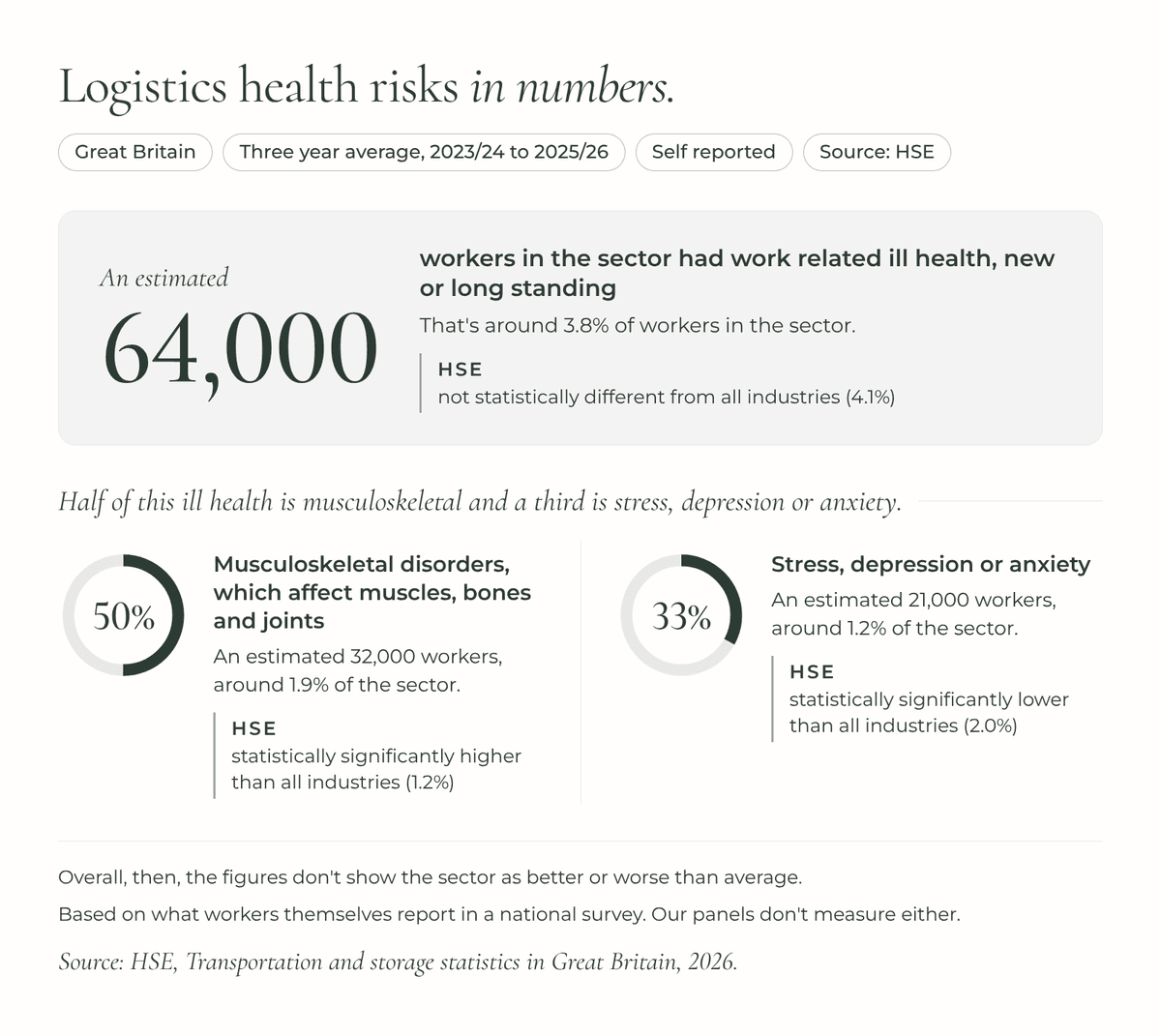
Half of this ill health is musculoskeletal and a third is stress, depression or anxiety. Our panels don't measure either. Screening has a different job: a look at each person's own general health.
Is screening a driver medical?
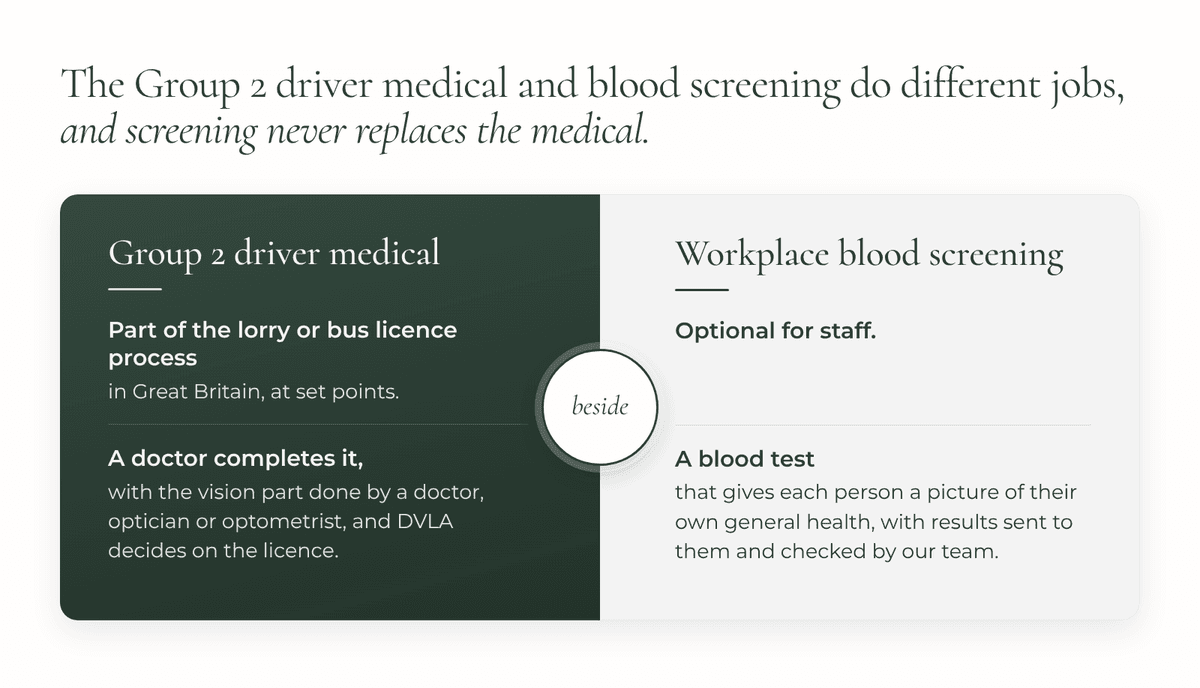
The Group 2 driver medical is part of the licence process, and blood screening is a separate thing that never replaces it.
No. The driver medical has its own job.
Group 2 licences cover large lorries (category C) and buses (category D). The Driver and Vehicle Licensing Agency (DVLA) says that in most cases the medical standards for Group 2 drivers are substantially higher than for Group 1 drivers. A new Group 2 applicant needs a D4 medical examination completed by a registered medical practitioner. In Great Britain, a lorry or bus driver renewing at 45 or over asks a doctor to complete the D4. The vision part can be completed by a doctor, optician or optometrist. It forms part of the driver's own licence application, and DVLA decides on the licence.
Our blood tests aren't a driver medical or a fitness to drive assessment. They aren't accepted in place of the D4.
Night work carries a separate duty. Employers must offer night workers a free health assessment before they start night work, and regular assessments after that. For lorry drivers, GOV.UK lists health checks for night workers among the working time provisions that affect mobile workers. A screening day isn't that assessment. The Livewell Syndicate doesn't offer night worker health assessments, health surveillance or biological monitoring.
Group 2 driver medical
Part of the lorry or bus licence process in Great Britain, at set points. A doctor completes it, with the vision part done by a doctor, optician or optometrist, and DVLA decides on the licence.
Workplace blood screening
Optional for staff. A blood test that gives each person a picture of their own general health, with results sent to them and checked by our team.
A blood screen gives each person their own numbers for markers such as blood sugar and cholesterol, in about 20 minutes at work.
Workplace health screening for logistics
What the blood tests cover, what one study on shift work found, and what each person can do with their results.
Employers usually choose the Advanced Essential Blood Test, or the Advanced Well Man and Advanced Well Woman Blood Tests. The Advanced Essential covers 43 markers, including cholesterol and haemoglobin A1c (HbA1c). HbA1c measures your average blood sugar level over the last 2 to 3 months. The Well Man and Well Woman tests include HbA1c and cholesterol too, along with markers for the kidneys, iron and the thyroid.
If your people work shifts, one study is worth knowing. It looked at more than 270,000 working adults aged 38 to 71 in the UK, in all kinds of jobs, not logistics. People on rotating or irregular shifts that included nights were more likely to have type 2 diabetes than day workers. People on permanent nights didn't show the same difference. The study was a snapshot in time, so it can't show which came first or that shift work causes diabetes. Diabetes was identified from people's own histories and medication, not from blood tests.
A screening gives each person their own HbA1c and cholesterol readings. Each result comes with an explanation of what the marker measures and what it can and can't show. If a result sits outside the laboratory's range, it's something for that person to take to their GP. For more, read what a workplace blood test can and can't tell you.
Can screening fit around shifts?
How a screening day can be planned around shift patterns, from start times to night shifts.
Yes, with some planning. How much room there is depends on the tests you choose.
Start times agreed with you
We agree the start time with you, and samples are usually taken before 11:00.
Other times for some tests
Tests that aren't time dependent can be taken at other times of day, assessed panel by panel. Tests that include testosterone need a morning sample.
Night shifts by arrangement
Sessions for people working nights may be possible by arrangement with us.
Booking around your rota
Staff book through our corporate booking portal, or we work from a list you provide, which you can draw up around your rota.
About 20 minutes each
Each appointment covers consent, any questions and the blood sample.
Missed slots
Catch up sessions or alternatives are usually available, arranged case by case, depending on your location and our availability.
Your site rules
Our practitioner can complete site inductions or wear site PPE where required, as long as you tell us in advance.
Preparation
We send each person their preparation instructions before the day. Fasting depends on the panel, and the Advanced Essential needs none.
To follow the whole day in order, read how an on site screening day works, from booking to report.
What does each side get?
Each person gets their own checked results, and you get anonymised trends, never individual results.
Each person gets their own results. You get a picture of the group with nobody identified.
Samples go to a UKAS accredited laboratory. Results usually come back within 24 to 48 hours, though more complex tests can take longer. Every result is checked by our team before it's released, and each person gets a secure email link to their own results portal. With their consent, their results can be shared, for example with their GP or occupational health.
You get a report of anonymised key trends across the group. You never see anyone's individual results, and no group figure is shown for fewer than 5 people. Who sees your results when your employer pays for screening explains privacy in full. If you run a smaller firm, can a small business offer corporate health screening? covers places and team size.
We run screening for employers in England. There's no minimum group size, though we recommend at least 20 people.
Common questions
Short answers to what logistics employers ask about workplace health screening.
Is workplace health screening a legal requirement in logistics?
General blood screening is something an employer chooses to offer, and it's optional for staff. Separately, lorry and bus drivers need the DVLA Group 2 medical at set points as part of their licence, and employers must offer night workers a free health assessment. Screening is neither of those.
Is blood screening the same as a driver medical?
No. Screening gives each person a picture of their own general health.
Can health screening be done for shift workers and night workers?
Yes, with planning. Start times are agreed with you, and sessions for night workers may be possible by arrangement.
How long does each appointment take?
About 20 minutes. That covers consent, any questions and the blood sample.
Do staff have to take part, and will we see their results?
Taking part is always optional for staff. You never see anyone's individual results. You get anonymised key trends for the group, and every result is checked by our team before it reaches the person.
Was this article helpful?
Screening for your team
On-site and clinic health screening, scoped to your organisation.
Book a discovery call
Daniel SnowWritten by · BSc (Hons), PGCE
This article is for general information only and is not medical advice. If you have symptoms or concerns, speak with a qualified clinician.