Workplace health screening for offices brings a qualified practitioner to your premises to take a blood sample from each person who takes a place. Each person gets their own results, checked by our team and explained, and you get anonymised trends for the group. It isn't an eye test or any other legal check, and it doesn't replace one.
If your office staff are in on different days, two questions usually come up first. Does this overlap with the checks we already provide, such as eye tests? And can people who are in on different days take part? The short answers are no, and yes, with some planning.
What HSE's figures show
What the Health and Safety Executive's 2026 figures show about work related ill health across all industries, and which kinds a blood test looks at.
The Health and Safety Executive (HSE) doesn't publish an ill health report for offices. Its headline figures cover all industries in Great Britain. In 2025/26, an estimated 1.8 million workers had work related ill health, new or long standing. The figures come from what workers report themselves.
HSE gives two figures by type. It estimates 891,000 workers had stress, depression or anxiety, which is 49% of all work related ill health. It estimates 477,000 had musculoskeletal disorders, which are problems with muscles, bones and joints, and that is 26%.
1.8 million
workers in Great Britain with work related ill health, all industries, 2025/26
891,000
of them with stress, depression or anxiety, 49% of work related ill health
477,000
of them with musculoskeletal disorders, 26% of work related ill health
About three quarters
the two shares together, our calculation from HSE's figures
Put together, those two shares make up about three quarters of work related ill health across all industries. The sum is ours; HSE gives each share separately. Our screening doesn't test for stress, depression, anxiety or musculoskeletal disorders. Screening has a different job: a look at each person's own general health.
Does screening replace eye tests?
The employer eye test for display screen equipment users is a legal duty, and blood screening is a separate thing that never replaces it.
No. Our blood tests aren't an eye test. They don't meet the display screen equipment (DSE) eye test duty, and they don't replace it.
HSE says employers must protect workers from the health risks of working with DSE. Its guidance says the regulations apply to workers who use DSE daily, for continuous periods of an hour or more. HSE says an employer must provide an eye test for a DSE user if they ask for one, and must pay for the test. It should be a full eye and eyesight test by an optometrist or doctor. Employers only have to pay for glasses if the test shows the person needs special glasses for DSE work.
That is HSE's summary for Great Britain, not legal advice. We can't tell you which of your staff count as DSE users.
Display screen equipment eye test
An eye test the employer must arrange and pay for when a DSE user asks for one. A full eye and eyesight test by an optometrist or doctor.
Workplace blood screening
Optional for staff. A blood test that gives each person a picture of their own general health, with results sent to them and checked by our team.
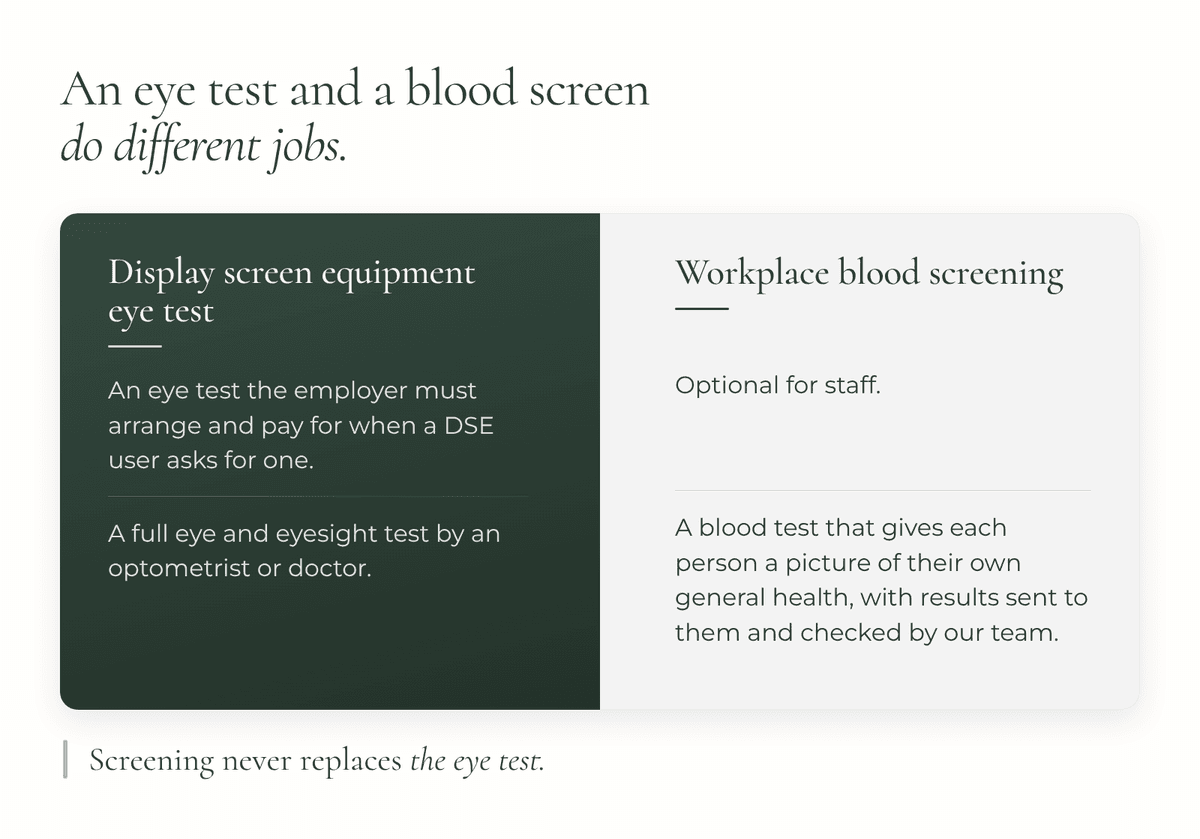
An eye test looks at eyes and eyesight. A blood screen looks at general health markers such as blood sugar and cholesterol. Each person gets their own numbers from an appointment of about 20 minutes, at work.
Workplace health screening for offices
What the blood tests cover, what research on sitting time shows, and what each person can do with their results.
Workplace health screening for offices starts with the choice of blood test. Employers typically pick the Advanced Essential Blood Test, or the Advanced Well Man and Advanced Well Woman Blood Tests.
The Advanced Essential covers 43 markers, including a full blood count, liver markers, cholesterol, haemoglobin A1c (HbA1c) and thyroid tests. HbA1c measures your average blood sugar level over the last 2 to 3 months. The Advanced Well Man and Advanced Well Woman Blood Tests include HbA1c and cholesterol too, along with markers for the kidneys, iron, vitamin D, folate, active B12 and the thyroid.
Research on sitting is worth knowing about. A 2018 review pooled 34 studies that followed about 1.3 million adults for 8.9 years on average. Total time spent sitting each day was linked with a higher risk of type 2 diabetes and of death from cardiovascular disease, after adjusting for physical activity. Most studies relied on people reporting their own sitting. The review measures total sitting across the day, not time at a desk, and as an observational study it can't show that sitting caused anything. What a screen gives each person is their own readings for markers such as HbA1c and cholesterol.
Each person's results come with an explanation of what each of their markers measures and what it can and can't show. If a result sits outside the laboratory's range, it's something for that person to take to their GP. For more on this, read what a workplace blood test can and can't tell you.
Can screening fit hybrid working?
How a screening day can be planned around office days, from start times to booking.
Yes, for people who are in the office on a screening day, with some planning. How much room there is depends on the tests you choose.
Start times agreed with you
We agree the start time with you, and samples are usually taken before 11:00.
Several days if you need them
A programme can run across several days with more than one practitioner, so you can plan it around office days.
Booking around who is in
Staff book through our corporate booking portal, or we work from a list you provide, which you can draw up around who is in on which day.
About 20 minutes each
Each appointment covers consent, any questions and the blood sample.
Missed slots
Catch up sessions or alternatives are usually available, arranged case by case, depending on your location and our availability.
A private room
You provide a private room and access to hand washing facilities for the practitioner.
Preparation
We send each person their preparation instructions before the day. Fasting depends on the panel, and the Advanced Essential needs none. Tests that include testosterone need a morning sample.
For the whole day in order, read how an on site screening day works, from booking to report.
What does each side get?
Each person gets their own checked results, and you get anonymised trends, never individual results.
Each person gets their own results, and you get a picture of the group with nobody identified.
Samples go to a UKAS accredited laboratory. Results usually come back within 24 to 48 hours, though more complex tests can take longer. Every result is checked by our team before it's released. Each person then gets a secure email link to their own results portal. With their consent, their results can be shared, for example with their GP or occupational health.
You get a report of anonymised key trends across the group. You never see anyone's individual results, and no group figure is shown for fewer than 5 people. Who sees your results when your employer pays for screening explains privacy in full. If you run a smaller firm, can a small business offer corporate health screening? covers places and team size.
We run screening for employers in England. There's no minimum group size, though we recommend at least 20 people.
Common questions
Short answers to what office based employers ask about workplace health screening.
Is workplace health screening a legal requirement for offices?
One duty HSE describes for people who use display screen equipment is an eye test when a DSE user asks for one. HSE also says health surveillance is not the same as health screening. Blood screening is something an employer chooses to offer, and it's optional for staff.
Does blood screening replace an eye test or other legal checks?
No. Screening gives each person a picture of their own general health.
Do employers have to pay for eye tests for office workers?
HSE says an employer must pay for an eye test for a DSE user who asks for one. Glasses are paid for only if the test shows special glasses are needed for DSE work. That is separate from blood screening.
Can hybrid staff take part in screening?
Yes, if they are in the office on a screening day. Staff book through our portal or from a list you provide, a programme can run across several days, and catch up sessions are usually available, arranged case by case.
How long does each appointment take?
About 20 minutes. That covers consent, any questions and the blood sample.
Do staff have to take part, and will we see their results?
Taking part is always optional for staff. You never see anyone's individual results. You get anonymised key trends for the group, and every result is checked by our team before it reaches the person.
Was this article helpful?
Screening for your team
On-site and clinic health screening, scoped to your organisation.
Book a discovery call
Daniel SnowWritten by · BSc (Hons), PGCE
This article is for general information only and is not medical advice. If you have symptoms or concerns, speak with a qualified clinician.